
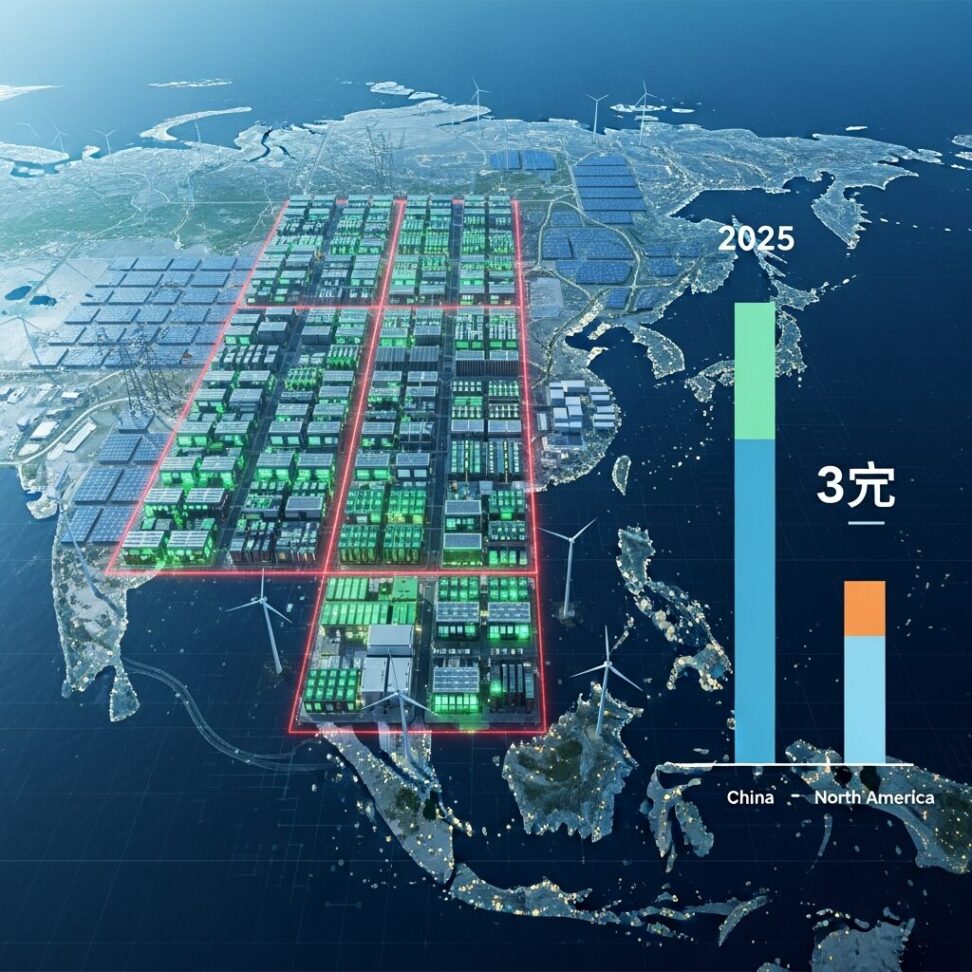
China’s Battery Storage Growth Outpaces North America Threefold
The global energy storage landscape is experiencing a significant shift as China establishes itself as the dominant force in battery storage installations. Recent data reveals that China’s battery storage deployment has surged ahead of North America by a factor of three, highlighting the country’s aggressive push toward renewable energy infrastructure and grid modernization.
The Numbers Behind the Surge
China’s commitment to energy storage has translated into concrete results. The country has been adding battery storage capacity at an unprecedented rate, driven by ambitious climate goals and the need to support its massive renewable energy installations. This threefold advantage over North America demonstrates not only China’s manufacturing capabilities but also its strategic approach to building a resilient energy grid.
The disparity in installation rates reflects different approaches to energy policy and infrastructure investment between the two regions. While North America has made progress in energy storage deployment, the pace remains considerably slower compared to China’s aggressive expansion strategy.
Factors Driving China’s Leadership
Several key elements contribute to China’s dominance in the battery storage sector:
- Government policy support and financial incentives for energy storage projects
- Domestic manufacturing capacity for battery components and systems
- Integration requirements for renewable energy projects
- Lower installation and equipment costs due to local supply chains
- Centralized planning that enables rapid infrastructure development
China’s battery storage expansion is closely tied to its renewable energy ambitions. As the world’s largest installer of solar and wind power, the country requires substantial storage capacity to manage the intermittent nature of these energy sources and maintain grid stability.
North America’s Position
Despite trailing behind China in absolute numbers, North America has been steadily increasing its battery storage capacity. The United States and Canada have seen growing interest from utilities, commercial entities, and residential customers in energy storage solutions. However, regulatory frameworks, permitting processes, and higher costs have slowed the deployment rate compared to China’s streamlined approach.
The North American market faces unique challenges including varied state and provincial regulations, interconnection requirements, and market structures that can complicate large-scale storage projects. These factors contribute to longer project timelines and higher development costs.
Global Implications
China’s lead in battery storage installations has broader implications for the global energy transition. The country’s experience in deploying large-scale storage systems provides valuable insights into grid integration, operational challenges, and economic models for energy storage projects.
This growth pattern also affects global supply chains for battery materials and components. China’s dominance in lithium-ion battery production, combined with its massive domestic deployment, creates economies of scale that influence pricing worldwide.
Technology and Innovation
The rapid expansion in China includes deployment of various storage technologies, with lithium-ion batteries remaining the predominant choice. The country is also exploring alternative chemistries and storage methods to diversify its technology portfolio and address specific grid needs.
Chinese companies are investing heavily in battery technology research and development, aiming to improve energy density, safety, and lifespan while reducing costs. This innovation cycle benefits from the large domestic market that provides real-world testing opportunities at scale.
Looking Ahead
The gap between China and North America in battery storage installations is likely to persist in the near term. China’s integrated approach to renewable energy and storage deployment, combined with its manufacturing advantages, positions it to maintain its leadership role.
For North America to close this gap, sustained policy support, streamlined regulatory processes, and continued cost reductions will be essential. Some industry observers expect North American deployment to accelerate as storage economics improve and regulatory barriers diminish.
The competition in energy storage deployment reflects broader trends in the global energy transition. As countries work toward decarbonization goals, battery storage will play an increasingly critical role in enabling renewable energy integration and grid reliability. China’s current lead demonstrates the impact of coordinated policy, manufacturing capacity, and infrastructure investment in advancing clean energy technology deployment.
Analyzed and outlined by Claude Sonnet 4.5, images by Gemini Imagen 4.
**Source**
https://caliber.az/en/post/china-s-added-battery-storage-installations-tripled-north-america-s-in-2025