
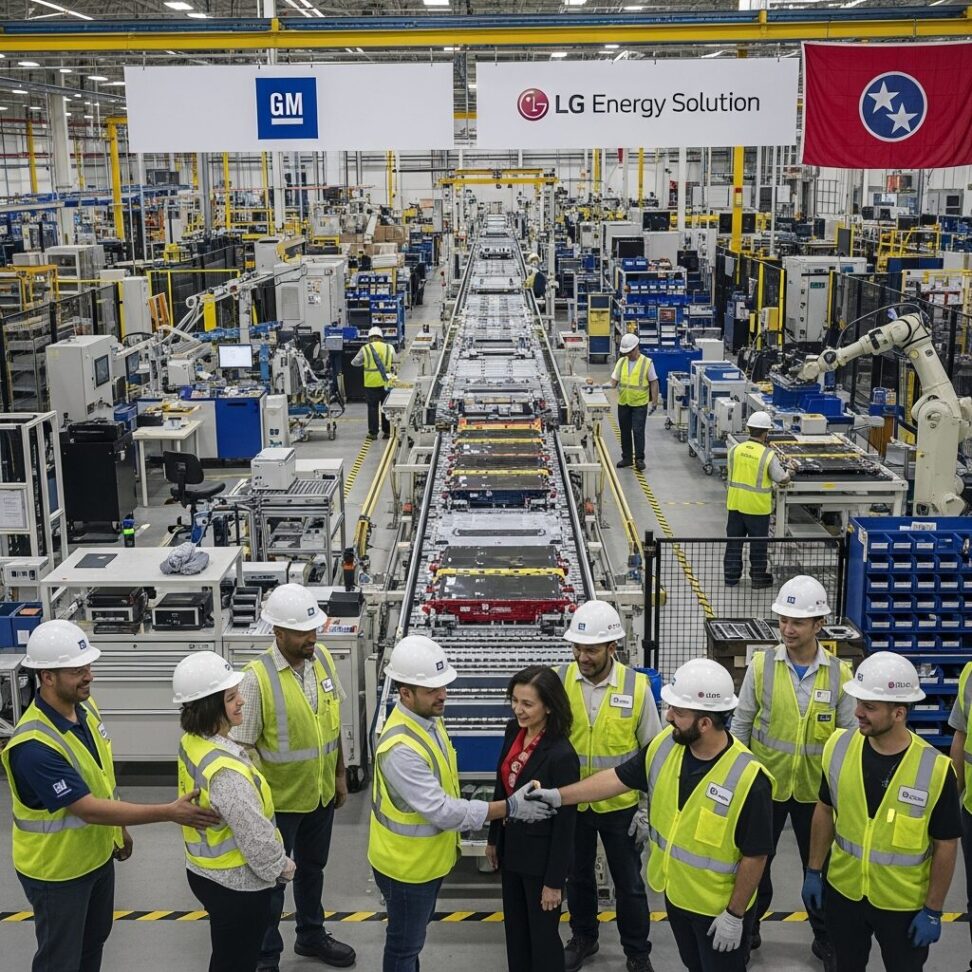
GM and LG Expand Tennessee Battery Production for AI Energy Storage
The automotive industry continues to evolve beyond traditional vehicle manufacturing as General Motors and LG Energy Solution shift their Tennessee battery production facility to meet growing demands in artificial intelligence infrastructure. The joint venture, known as Ultium Cells LLC, is recalling approximately 700 workers to their Spring Hill, Tennessee plant to produce energy storage systems for data centers.
Understanding the Companies Behind the Expansion
General Motors, one of America’s largest automotive manufacturers, has been in business for over a century, producing vehicles under brands including Chevrolet, GMC, Cadillac, and Buick. LG Energy Solution is a South Korean company that ranks among the world’s leading battery manufacturers, specializing in lithium-ion batteries for electric vehicles and energy storage systems.
Together, these companies formed Ultium Cells LLC, a joint venture dedicated to producing next-generation battery cells and systems for electric vehicles and other applications requiring advanced energy storage technology.
The Shift Toward AI Infrastructure
The decision to redirect battery production reflects the increasing energy demands of artificial intelligence systems. Data centers that power AI applications require substantial amounts of electricity, and energy storage solutions have become critical for managing power supply and maintaining operational stability.
The Tennessee facility, which had experienced workforce reductions earlier, is now ramping up production to address this emerging market. The recall of 700 employees signals a substantial commitment to meeting the energy storage needs of the technology sector.
Details of the Production Expansion
The Spring Hill plant will focus on manufacturing battery systems specifically designed for data center applications. These energy storage units differ from automotive batteries in their configuration and deployment, though they utilize similar core technology developed for electric vehicles.
The facility benefits from existing infrastructure and a trained workforce familiar with battery production processes. Workers returning to the plant will adapt their skills to produce these specialized energy storage systems, which require precise assembly and quality control standards.
Economic Impact on Tennessee
The workforce recall represents significant economic activity for the Spring Hill area. The 700 returning employees will contribute to the local economy through wages and spending, while the plant’s expanded operations will likely generate additional economic benefits through supply chain relationships and service providers.
Tennessee has positioned itself as a hub for automotive and battery manufacturing, with multiple facilities operated by various manufacturers throughout the state. This latest development reinforces the region’s role in the transition to electric vehicles and energy storage technologies.
The Growing Energy Storage Market
Energy storage systems have become increasingly important as businesses and utilities seek to manage power supplies more effectively. For data centers, battery storage provides several key functions:
- Backup power during outages or grid disruptions
- Load balancing to smooth out demand peaks
- Integration with renewable energy sources
- Cost management through strategic charging and discharging
The AI boom has accelerated demand for these systems, as machine learning operations consume substantial electricity and require consistent power delivery to maintain operations.
Implications for the Automotive Industry
The pivot toward energy storage production demonstrates how automotive battery manufacturers are diversifying their product lines. While electric vehicle production remains a primary focus for both GM and LG Energy Solution, the ability to serve multiple markets provides financial stability and growth opportunities.
This flexibility allows battery manufacturers to adapt to market conditions and capitalize on emerging technologies. The skills and infrastructure developed for automotive applications transfer readily to stationary energy storage, creating synergies between different business segments.
Looking Forward
The expansion at the Spring Hill facility indicates that both GM and LG Energy Solution see substantial long-term potential in the energy storage market. As AI applications continue to proliferate and data center construction accelerates, demand for reliable power storage solutions is expected to grow.
The Tennessee plant’s transition from reduced operations to full-scale production for a new market segment illustrates the dynamic nature of modern manufacturing. Companies that can adapt their capabilities to serve emerging needs are better positioned to succeed in a changing economic landscape.
For the 700 workers returning to the plant, this development provides employment stability and the opportunity to participate in an expanding sector of the economy. The intersection of automotive technology, artificial intelligence, and energy management creates new pathways for industrial development and job creation.
Analyzed and outlined by Claude Sonnet 4.5, images by Gemini Imagen 4.
**Source**
https://www.gmtoday.com/autos/gm-and-lg-bring-back-700-tennessee-workers-to-make-batteries-for-ai/article_b3463c1c-684c-450b-8fcd-3ec805f73bf4.html