
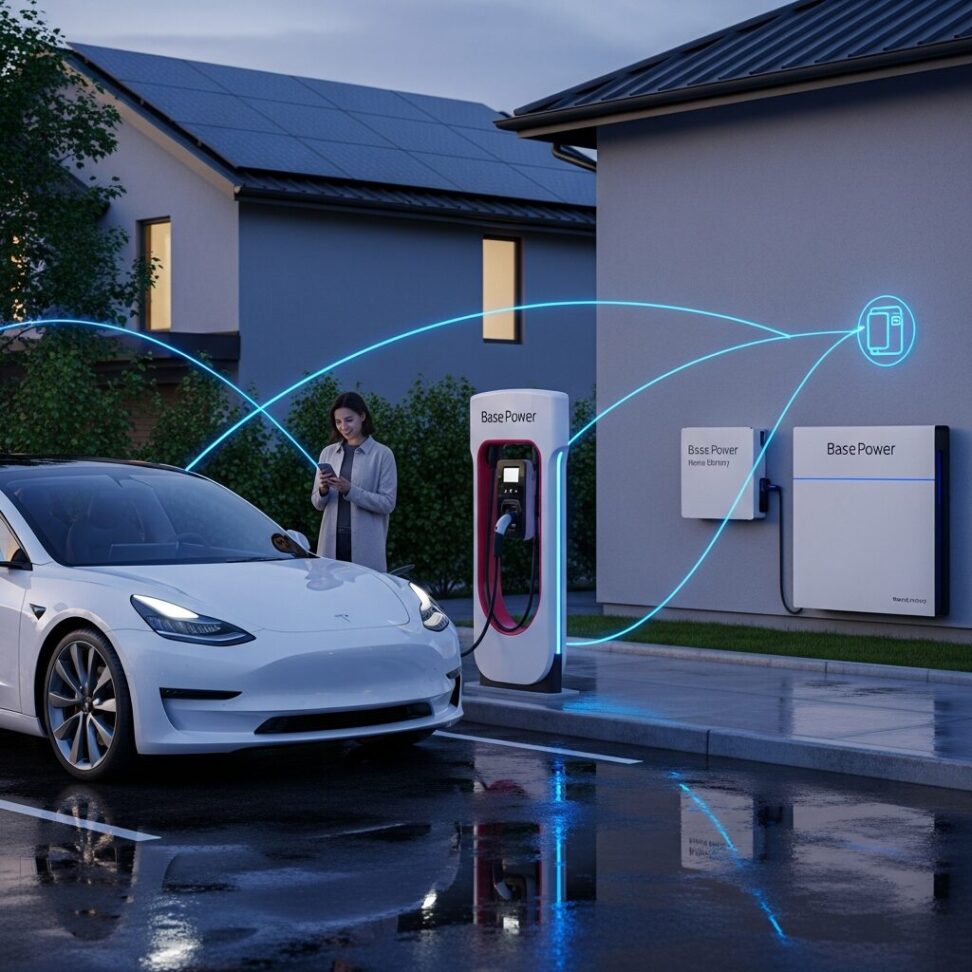
Base Power’s Challenge to Tesla’s Residential Energy Dominance
A new contender is emerging in the residential battery storage market, and it’s setting its sights on one of the industry’s biggest names. Base Power, an Austin-based energy startup, is positioning itself as a serious competitor to Tesla’s Powerwall, offering homeowners a different approach to backup power and grid participation.
Who Is Base Power?
Base Power is a Texas-based energy company founded in 2023 that provides home battery backup systems bundled with electricity service. Rather than selling batteries outright at a steep upfront cost, Base offers customers a subscription-style model where the company installs a battery at the home for a low installation fee, and customers pay for their electricity through Base as their retail provider. The company retains control of the battery, using it to support the grid while providing backup power to the customer during outages.
A Different Business Model
Tesla’s Powerwall has long dominated the residential storage conversation, with homeowners typically paying upwards of $10,000 or more upfront to purchase and install the unit. Base Power flips that equation. By charging a small installation fee (reportedly starting around $595 to $995) and folding the battery cost into ongoing electricity service, Base lowers the barrier to entry for homeowners who want backup power without the substantial capital expense.
This approach also allows Base to aggregate its installed batteries into a virtual power plant, dispatching stored energy back to the grid during peak demand periods. The revenue generated from grid services helps subsidize the hardware costs, creating a sustainable economic model that differs sharply from Tesla’s product-sale approach.
Rapid Growth in Texas
Base Power has been scaling quickly within the ERCOT (Electric Reliability Council of Texas) market, where deregulated electricity and frequent grid stress events create ideal conditions for distributed storage. The company raised $200 million in a Series B funding round in late 2024, led by Andreessen Horowitz and Valor Equity Partners, signaling strong investor confidence in its model.
Texas has become a natural proving ground for residential storage innovation following the devastating February 2021 winter storm that left millions without power. Homeowners in the state have shown increased willingness to invest in resilience, and Base is capitalizing on that demand.
How It Compares to Tesla
The differences between the two offerings extend beyond price structure:
- Ownership: Tesla customers own their Powerwall outright, while Base retains ownership of its batteries.
- Electricity service: Base bundles retail electricity with the hardware; Tesla does not provide electricity service.
- Grid participation: Both companies operate virtual power plant programs, but Base’s model is built around it from day one.
- Upfront cost: Base’s entry cost is a fraction of Tesla’s, though customers commit to Base as their electricity provider.
- Geographic reach: Tesla operates nationally and internationally, while Base is currently focused on Texas.
Challenges Ahead
Base still faces meaningful hurdles. Its geographic footprint remains limited compared to Tesla’s global reach, and expanding beyond Texas will require navigating different regulatory environments and utility structures. Not every state has the deregulated retail market that makes Base’s bundled electricity