
How Eclipse Events Impact Solar Energy Production Across North America
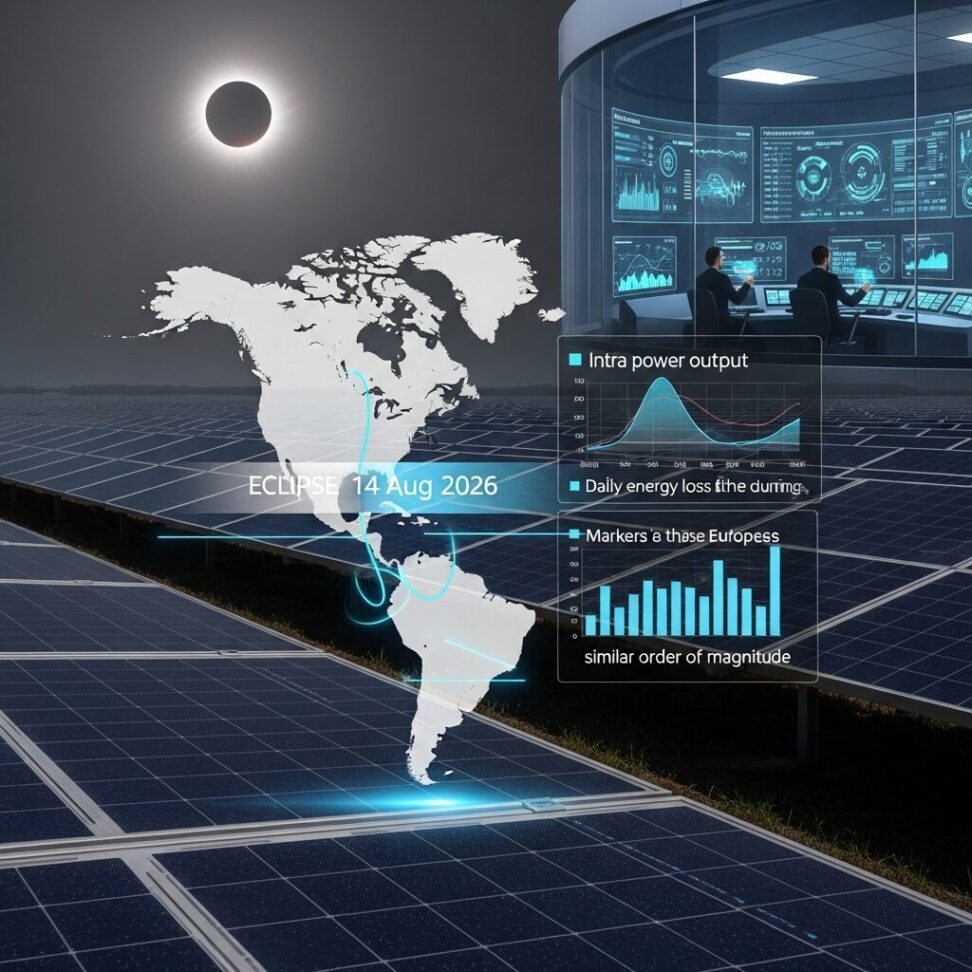
On 14 August 2026, a partial solar eclipse crossed parts of North America, temporarily changing the amount of sunlight reaching the ground. While an eclipse is short-lived compared with seasonal weather patterns, its effects on solar generation can still be measured as a drop in power output during the period of maximum obscuration. A new analysis published by pv magazine highlights an important takeaway for solar forecasting: the daily energy losses during the U.S. partial eclipse were similar in scale to the kind of day-to-day solar reductions seen in European locations with higher levels of sky obscuration.
What the partial eclipse did to solar power
Solar PV plants convert sunlight into electricity, so any event that reduces irradiance—clouds, haze, smoke, or an eclipse—will lower output. During the eclipse window, the Sun’s apparent dimming blocks some portion of incoming solar radiation, typically concentrating the impact into a narrower timeframe than many weather fronts.
For operators and analysts, the key point is that even a partial eclipse can produce a noticeable change in:
- Near-term power ramps and curtailment needs
- Intraday forecast error if models do not account for predictable astronomical events
- Daily energy totals, not just hourly generation
The study emphasized that the eclipse did not merely cause momentary dips—it also translated into measurable daily solar energy losses relative to normal conditions.
How eclipse losses compared with Europe’s “higher obscuration” locations
The analysis compared the eclipse day’s solar generation impact in North America with conditions in Europe where sky obscuration is higher—a reference to recurring visibility and irradiance-limiting factors such as clouds, aerosols, and other atmospheric effects. The result: the eclipse-driven reduction in daily solar energy was of a similar order of magnitude to those observed in European regions that routinely experience greater obscuration.
This comparison matters because it links an astronomical event to the same forecasting and grid-planning categories used for meteorological variability. In other words, the eclipse behaves like a predictable, short-duration “irradiance disturbance” with a daily energy consequence comparable to certain weather-prone geographies.
Why this matters for solar forecasting and grid planning
Grid operators balance supply and demand minute-by-minute. Solar adds variability because PV output depends on the real-time availability of irradiance. Eclipse events are rare, but they are fully predictable in timing and location coverage—meaning forecasts can be improved if eclipse