
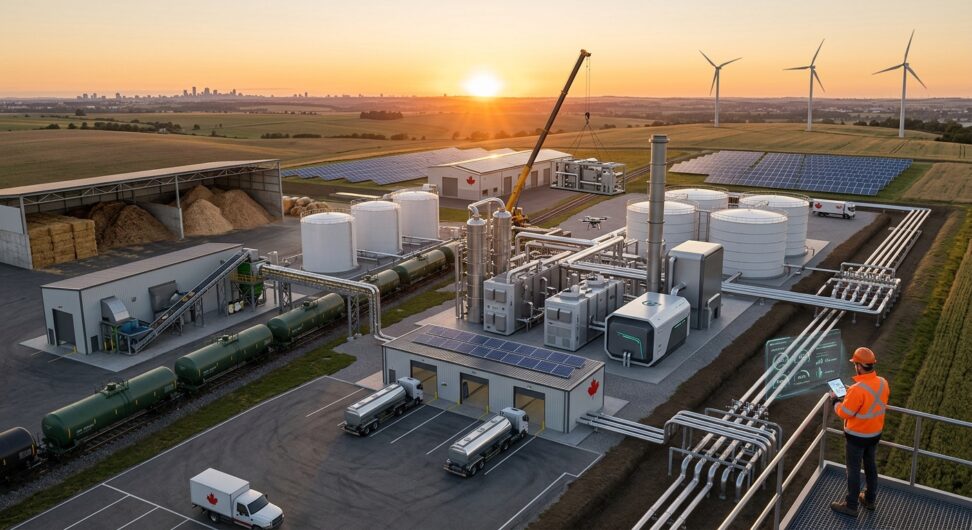
Canadian Renewable Fuels Company Transforms Clean Infrastructure Development
The renewable fuels sector in Canada continues to attract attention as companies work to build out infrastructure that supports the shift away from traditional fossil fuel dependency. A Canadian renewable fuels company has emerged as a notable player in this space, focusing its efforts on developing clean infrastructure projects that aim to reshape how energy is produced, stored, and distributed across North America.
Building Clean Energy Infrastructure
The company’s approach centers on infrastructure development that supports renewable fuel production at scale. This includes facilities designed to process biomass, waste streams, and other feedstocks into usable renewable fuels that can replace conventional petroleum-based products in transportation and industrial applications.
Infrastructure projects of this type typically require substantial capital investment and long development timelines, often spanning several years from initial planning to full operational status. Companies in this space must navigate regulatory approvals, secure feedstock supply agreements, and establish distribution networks before production can begin at commercial scale.
Market Context and Industry Trends
Canada’s renewable fuels sector operates within a broader North American push toward decarbonization. Federal and provincial policies have created incentive structures for companies willing to invest in renewable fuel production, including tax credits and clean fuel standards that mandate reductions in carbon intensity across the transportation sector.
These policy frameworks have encouraged private investment in renewable diesel, sustainable aviation fuel, and renewable natural gas projects throughout the country. Companies pursuing infrastructure development in this space often cite the following factors as drivers of their business strategy:
- Growing demand for low-carbon fuel alternatives from transportation and industrial sectors
- Government incentive programs supporting clean fuel production
- Corporate sustainability commitments from major fuel purchasers
- Technological advances reducing production costs for renewable fuels
- Expanding feedstock availability from agricultural and waste sources
Project Development Challenges
Developing clean infrastructure at the scale required for commercial renewable fuel production presents ongoing challenges. Capital intensity remains a primary obstacle, as facilities require significant upfront investment before generating revenue. Companies must also manage feedstock price volatility, as the cost of raw materials can fluctuate based on agricultural market conditions and competing uses for biomass.
Supply chain considerations add another layer of complexity. Transporting feedstock to processing facilities and distributing finished renewable fuel products requires coordination with existing energy infrastructure, including pipelines, rail networks, and storage terminals. Companies that can integrate with established distribution systems often gain an advantage in bringing projects to market efficiently.
Regulatory Environment
Canada’s clean fuel regulations, which took effect in recent years, require fuel suppliers to gradually reduce the carbon intensity of the fuels they produce and import. This regulatory structure has created a market for credits that renewable fuel producers can generate and sell, providing an additional revenue stream beyond direct fuel sales.
Provincial governments have also introduced their own incentive programs, with some regions offering additional support for projects that create local jobs or process regional agricultural waste products. This layered regulatory approach means companies operating in the space must maintain compliance across multiple jurisdictions while optimizing for available incentives.
Looking Ahead
The renewable fuels sector in Canada is expected to continue expanding as infrastructure projects move from development to operational phases. Companies that successfully navigate the capital requirements, regulatory landscape, and supply chain challenges associated with these projects stand to benefit from growing demand for low-carbon fuel alternatives.
As more facilities come online, the renewable fuels industry will likely play an increasingly significant role in Canada’s broader energy transition strategy, complementing other clean energy sources such as wind, solar, and hydroelectric power in reducing the country’s overall carbon footprint.
Industry observers note that the success of individual companies in this space will depend on their ability to execute complex infrastructure projects on schedule and within budget, while maintaining the operational flexibility needed to respond to evolving policy frameworks and market conditions.
Analyzed and outlined by Claude Sonnet 5, images by Gemini 3.1 Flash
**Source** https://stockhouse.com/opinion/contributors/2026/10/02/knorr-bremse-power-metallic-mines-rational-a-look-behind-scenes-and-up-to-150