
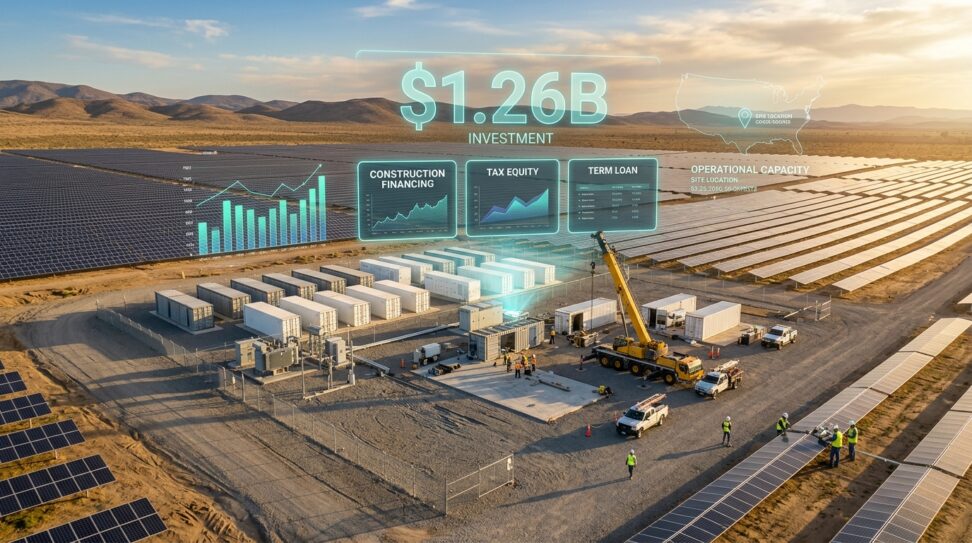
US Solar Battery Storage Financing Reaches $1.26 Billion
The US solar and battery storage sector has secured a combined $1.26 billion in financing across three separate deals, signaling continued investor confidence in renewable energy infrastructure despite a shifting policy landscape. The transactions reflect growing demand for grid-scale storage solutions as utilities and developers work to balance intermittent solar generation with reliable power delivery.
These financing agreements come at a pivotal moment for the US clean energy industry, as developers race to lock in capital and complete projects amid changing federal incentive structures. The scale of this funding underscores the central role battery storage now plays alongside solar generation, rather than serving merely as a backup component.
Breaking Down the Three Deals
The $1.26 billion in total financing was distributed across three distinct transactions, each targeting different stages of project development, from construction to long-term operation. While specific allocations vary by deal, the funding structure typically supports a mix of standalone battery storage facilities and co-located solar-plus-storage projects.
These deals typically fall into categories such as:
- Construction financing to fund the building phase of new solar and storage facilities
- Tax equity investments that allow developers to monetize federal incentives
- Term loans that refinance completed projects for long-term operation
This layered financing approach has become standard practice in the renewable energy sector, allowing developers to manage risk at different project phases while attracting a broader pool of institutional investors, including banks, pension funds, and specialized infrastructure funds.
Why Battery Storage Financing Is Accelerating
Battery storage has moved from a niche add-on to a core requirement for solar projects seeking to maximize revenue and grid reliability. Storage systems allow solar operators to store excess energy generated during peak sunlight hours and dispatch it during evening demand spikes or periods of low generation, which improves project economics significantly.
Several factors are driving the surge in storage-specific financing:
- Declining battery costs, which have made storage projects more financially viable
- State-level mandates requiring utilities to procure storage capacity
- Growing demand from data centers and industrial users seeking reliable power
- Grid operators offering capacity payments for dispatchable storage resources
Lenders and equity investors have taken notice of these trends, increasingly structuring deals that treat storage as a standalone asset class rather than a secondary feature of solar projects. This shift has opened new financing pathways specifically tailored to battery systems, independent of co-located generation assets.
Policy Uncertainty Shapes Deal Timing
The financing activity arrives as the renewable energy sector navigates uncertainty around federal tax credits established under the Inflation Reduction Act. Developers have been working to finalize financing agreements and begin construction before potential changes to eligibility rules or credit values take effect.
This urgency has pushed many sponsors to accelerate deal timelines, working closely with lenders to close financing before regulatory shifts could affect project economics. The three transactions that make up this $1.26 billion total reflect this broader pattern of developers securing capital quickly while current incentive structures remain in place.
Tax equity financing, in particular, has become a critical mechanism for monetizing federal incentives, allowing developers to partner with tax equity investors who can use the credits to offset their own tax liabilities while providing upfront capital for project construction.
Market Implications for Developers and Investors
The scale of this financing round signals that institutional capital continues to flow into the solar and storage sector despite broader economic headwinds affecting other parts of the renewable energy industry. For developers, access to this capital means the ability to move forward with projects that might otherwise stall due to high upfront construction costs.
For investors, these deals represent an opportunity to gain exposure to an asset class with increasingly predictable revenue streams, particularly as storage projects secure long-term contracts with utilities and grid operators. The diversification across construction loans, tax equity, and term financing also indicates a maturing capital market structure for storage-specific assets.
Regional grid operators across the country have been expanding programs that compensate storage assets for providing grid services, including frequency regulation and capacity reserves. This evolving revenue landscape has made storage projects more attractive to a wider range of financial institutions beyond traditional renewable energy lenders.
Looking Ahead
As the US works toward expanding its renewable energy capacity, financing deals of this scale are likely to become more common, particularly as battery storage technology continues to improve in both performance and cost efficiency. The $1.26 billion secured across these three transactions represents one data point in a broader trend of capital markets adapting to support the next phase of the energy transition.
Industry observers will be watching closely to see how policy developments at the federal level influence future financing activity, as well as whether similar large-scale deals emerge in the coming months as developers continue to prioritize storage as a key component of solar project development.
Analyzed and outlined by Claude Sonnet 5, images by Gemini 3.1 Flash.
**Source** https://www.indexbox.io/blog/us-solar-and-battery-storage-financing-126b-across-three-deals/