
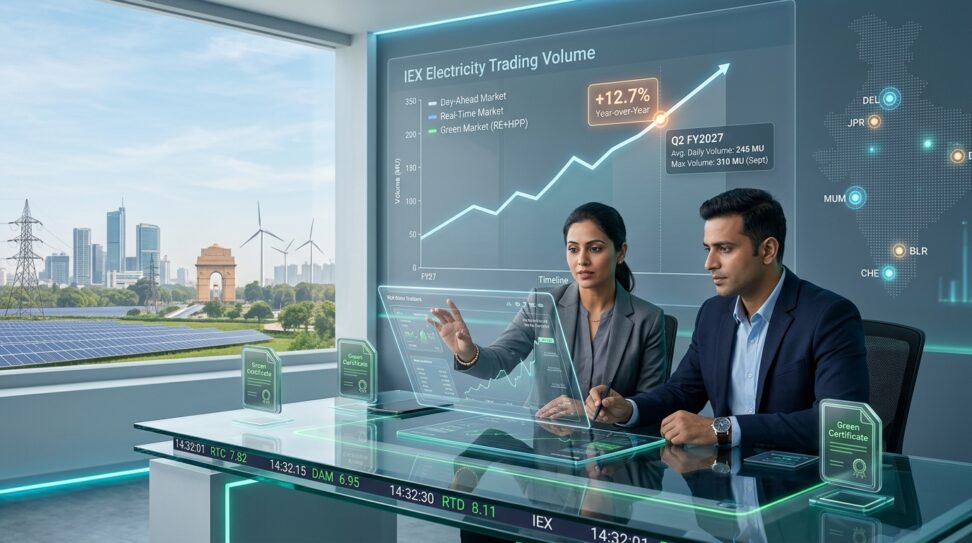
IEX Electricity Trading Volume Surges 12.7% Year-over-Year Q2 2027
The Indian Energy Exchange (IEX) has reported a 12.7% year-over-year increase in electricity trading volume for the second quarter of fiscal year 2027, reflecting sustained demand growth across the country’s power trading landscape. The exchange, which serves as India’s primary platform for electronic trading of electricity and renewable energy certificates, continues to play a central role in the nation’s shift toward a more liquid and transparent power market.
IEX, headquartered in New Delhi, operates as a national-level power exchange where utilities, industries, and open-access consumers can buy and sell electricity through transparent price discovery mechanisms. Since its launch, the platform has grown into one of the primary venues for short-term power trading in India, offering contracts across the day-ahead market, real-time market, term-ahead market, and green market segments.
Breaking Down the Q2 FY2027 Numbers
The reported growth in trading volume during Q2 FY2027 signals continued momentum in short-term electricity trading, a segment that has steadily gained share relative to long-term bilateral power purchase agreements. Market participants have increasingly turned to exchange-based trading for its flexibility, competitive pricing, and ability to respond quickly to shifting demand and supply conditions.
Several factors typically contribute to volume growth on exchanges like IEX, including:
- Rising electricity demand from industrial and commercial sectors
- Greater participation from state utilities seeking cost-effective power procurement
- Expansion of renewable energy capacity requiring flexible trading mechanisms
- Increased adoption of open access by commercial and industrial consumers
- Growing integration of real-time market segments into daily power scheduling
The Role of Renewable Energy in Trading Growth
Renewable energy continues to be a significant driver of activity on power exchanges in India. As solar and wind capacity additions accelerate nationwide, the variability inherent in renewable generation has pushed utilities and generators toward short-term markets to balance supply and demand in real time. The Green Market segment on IEX, which facilitates trading of renewable energy specifically, has become an increasingly important tool for distribution companies and corporate buyers seeking to meet renewable purchase obligations.
Corporate demand for green power through open access channels has also expanded, as businesses pursue sustainability targets and seek to hedge against rising conventional power costs. This trend has added depth to the exchange’s trading volumes, particularly in the green day-ahead and green term-ahead segments.
Market Dynamics Behind the Growth
India’s electricity sector has been undergoing structural changes that favor exchange-based trading. The gradual rollout of market-based economic dispatch, along with regulatory support for expanding the scope of power exchanges, has encouraged more participants to route their transactions through platforms like IEX rather than relying solely on long-term contracts.
State electricity distribution companies, often operating under tight financial constraints, have found short-term procurement through exchanges to be a practical way to manage seasonal demand fluctuations without committing to long-term liabilities. This has been particularly relevant during peak demand periods driven by weather extremes, when exchange prices offer a transparent benchmark for power availability.
Implications for the Renewable Energy Sector
The sustained growth in IEX trading volume carries broader implications for India’s renewable energy transition. As more wind and solar capacity comes online, the ability to trade power efficiently in real time becomes essential to maintaining grid stability. Power exchanges provide the infrastructure needed to absorb variable renewable output and match it with demand across different regions and time blocks.
This growth also reflects increasing market maturity, with participants becoming more comfortable using exchange mechanisms for both conventional and renewable power. The expansion of real-time market segments has been particularly beneficial for renewable generators, who can now adjust their trading positions closer to actual delivery time, reducing imbalance costs and improving overall grid efficiency.
Looking Ahead
The 12.7% year-over-year volume increase reported for Q2 FY2027 suggests that India’s power trading ecosystem continues to expand in both scale and sophistication. As renewable energy penetration deepens and more states adopt market-based procurement strategies, exchanges like IEX are likely to see continued volume growth in the coming quarters.
Industry observers will be watching how regulatory developments, including potential changes to market coupling and the expansion of ancillary services markets, shape trading patterns going forward. For now, the data points to a power market that is becoming increasingly dynamic, with short-term trading playing a growing role in how India balances its electricity supply and demand.
Analyzed and outlined by Claude Sonnet 5, images by Gemini 3.1 Flash.
**Source** https://www.mercomindia.com/iex-electricity-trading-volume-rises-12-7-yoy-in-q2-fy-2027