
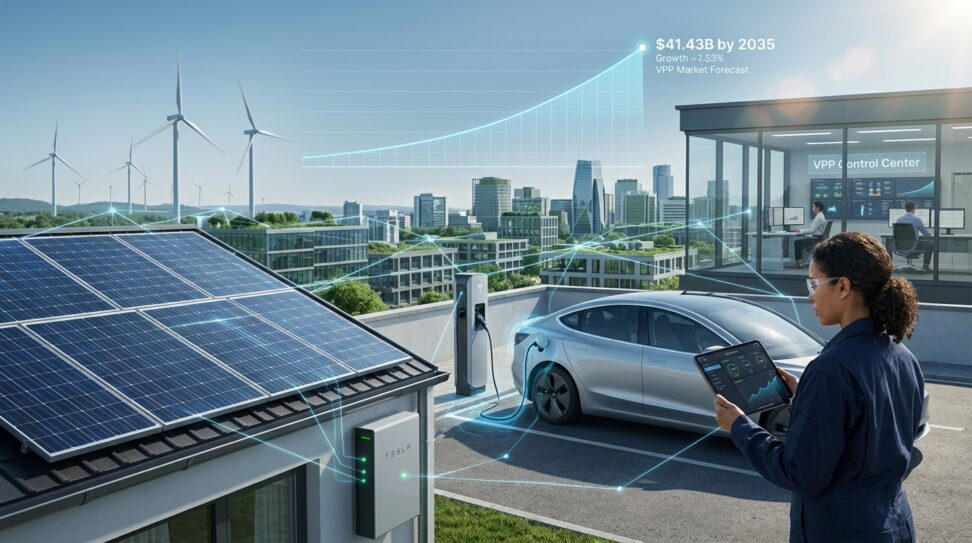
Virtual Power Plant Market Grows to $41.43 Billion by 2035
The global virtual power plant (VPP) market is on track for substantial expansion over the next decade, with projections indicating growth to $41.43 billion by 2035. This surge reflects the accelerating shift toward decentralized energy systems, increased adoption of distributed energy resources, and the growing need for grid flexibility as renewable energy penetration deepens worldwide.
Understanding Virtual Power Plants
A virtual power plant is a network of decentralized, small-scale energy resources such as solar panels, battery storage systems, electric vehicles, and demand response units that are aggregated and coordinated through software platforms. Rather than relying on a single large power station, a VPP combines these distributed assets to function collectively as a flexible, controllable power source that can respond to grid demands in real time.
This technology allows utilities and grid operators to balance supply and demand more efficiently, integrate higher shares of renewable energy, and reduce the need for traditional fossil-fuel-based peaker plants.
Key Drivers Behind Market Growth
Several factors are fueling the rapid expansion of the VPP market:
- Rising integration of renewable energy sources like solar and wind, which require flexible balancing mechanisms
- Growing deployment of smart grid infrastructure and advanced metering systems
- Increasing adoption of residential and commercial battery storage
- Expansion of electric vehicle fleets that can serve as mobile energy storage units
- Supportive government policies and incentives promoting decentralized energy models
- Rising electricity demand coupled with the need for grid resilience against outages
As energy systems become more complex, utilities are increasingly turning to VPPs as a cost-effective alternative to building new centralized power infrastructure.
Regional Market Outlook
North America currently holds a significant share of the VPP market, driven by strong regulatory support, advanced grid infrastructure, and widespread adoption of distributed energy resources in the United States. Europe follows closely, with countries such as Germany, the United Kingdom, and the Netherlands investing heavily in demand response programs and renewable integration.
The Asia-Pacific region is expected to witness the fastest growth rate during the forecast period, fueled by rapid urbanization, expanding renewable energy capacity in countries like China, Japan, India, and South Korea, as well as growing government initiatives to modernize aging grid systems.
Market Segmentation
The virtual power plant market can be segmented based on technology, application, and end-user. By technology, the market includes demand response, distributed generation, and mixed asset VPPs. By application, segments typically cover residential, commercial, and industrial sectors. On the end-user side, utilities and independent power producers represent major adopters, alongside grid operators seeking enhanced flexibility and reliability.
Mixed asset virtual power plants, which combine multiple distributed resources such as solar, storage, and demand response, are expected to see particularly strong demand as they offer the greatest operational flexibility and revenue potential for grid operators.
Industry Players Shaping the Market
Several companies are actively contributing to the development and deployment of VPP technologies globally. These include:
- Siemens AG, a German multinational conglomerate known for its energy management and automation technologies, providing software solutions for grid optimization
- General Electric, an American multinational company offering digital energy platforms that support VPP integration and grid management
- Enel X, the digital energy arm of Italian utility company Enel, specializing in demand response and distributed energy resource aggregation
- Tesla, the American electric vehicle and clean energy company, which has deployed VPP programs using its Powerwall battery systems in markets like Australia
- AutoGrid Systems, a software company focused on distributed energy resource management platforms for utilities
- Schneider Electric, a French multinational specializing in energy management and automation solutions
These companies, among others, are investing in software platforms, artificial intelligence-driven forecasting tools, and partnerships with utilities to expand VPP adoption across residential, commercial, and industrial segments.
Challenges Facing Market Expansion
Despite strong growth projections, the VPP market faces certain challenges. Regulatory frameworks in many regions remain inconsistent, creating uncertainty for market participants. Interoperability issues between different distributed energy resource technologies can also complicate aggregation efforts. Additionally, consumer awareness and participation in demand response programs remain limited in several developing markets, which could slow adoption rates.
Cybersecurity concerns are another consideration, as the increasing digitization of grid infrastructure creates potential vulnerabilities that need to be addressed through robust security protocols.
Looking Ahead
As the energy sector continues its transition toward decentralized, renewable-based systems, virtual power plants are positioned to play an increasingly important role in grid management. The projected growth to $41.43 billion by 2035 underscores the scale of investment and innovation expected in this space over the coming years.
Stakeholders across the energy value chain, from utilities and technology providers to policymakers and consumers, will need to collaborate closely to unlock the full potential of VPPs and build more resilient, flexible, and sustainable power systems for the future.
Analyzed and outlined by Claude Sonnet 5, images