
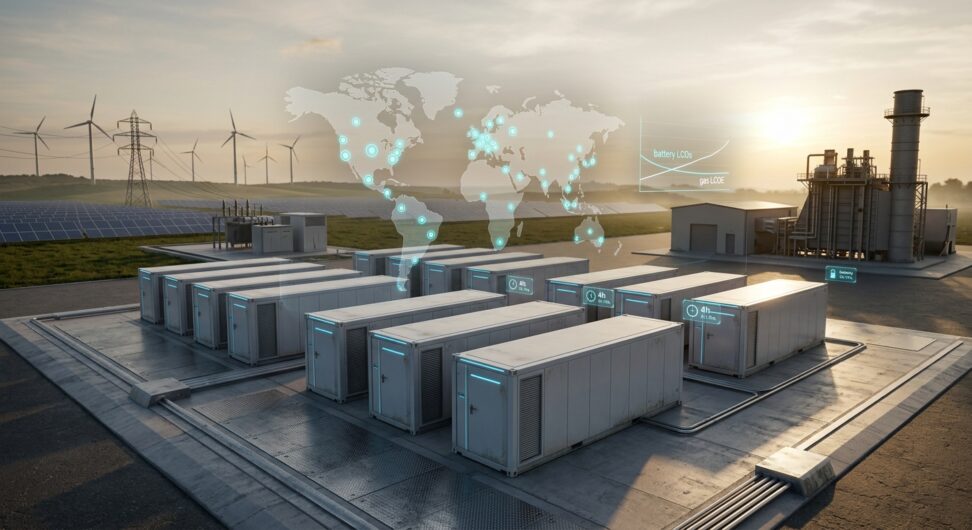
4-Hour Battery Storage Now Outcompetes Gas Turbines Across 43 Markets
Battery energy storage systems with four-hour duration have crossed a significant economic threshold, now undercutting the cost of natural gas peaker plants in 43 global markets. This shift marks a turning point for grid operators and utilities who have historically relied on gas turbines to meet peak electricity demand.
Battery Costs Continue Their Decline
The falling cost of lithium-ion battery storage has been the primary driver behind this competitive shift. Over the past decade, battery pack prices have dropped substantially, pushing down the levelized cost of storage (LCOS) for four-hour duration systems to levels that now beat the levelized cost of electricity (LCOE) from open-cycle gas turbines in a growing list of regions.
Four-hour battery systems are particularly relevant because they match the typical duration gas peaker plants are dispatched to cover demand spikes, making the comparison between the two technologies increasingly direct and relevant for grid planners.
Why 43 Markets Matter
The identification of 43 markets where batteries now beat gas turbines on cost signals that this is no longer a phenomenon limited to a handful of early-adopter regions with favorable subsidies or unusually high gas prices. Instead, the trend spans a broad and diverse set of geographies, suggesting the cost crossover is structural rather than situational.
Markets included in this shift span regions with varying regulatory environments, electricity demand profiles, and renewable energy penetration levels. The breadth of this list indicates that battery storage economics have matured to a point where they can compete against fossil fuel peaking capacity under a wide range of local conditions, rather than only in markets with ideal solar or wind resources.
Implications for Gas Turbine Investments
This cost crossover carries serious implications for future investment decisions in gas-fired peaking capacity. Utilities and independent power producers planning new generation assets will increasingly need to weigh the long-term economics of gas turbines against battery storage, particularly as:
- Battery costs are projected to continue falling in the coming years
- Gas turbines carry exposure to volatile fuel prices
- Regulatory frameworks increasingly favor low-carbon alternatives
- Battery systems offer faster response times and operational flexibility
For asset owners and financiers, this means new gas peaker projects face a higher risk of being economically outcompeted before their operational lifetime is complete, raising the specter of stranded assets in fossil fuel infrastructure.
Grid Flexibility and Renewable Integration
Beyond simple cost comparisons, four-hour battery storage offers additional benefits for grid operators managing increasing shares of variable renewable energy. Batteries can charge during periods of excess solar or wind generation and discharge during demand peaks, effectively smoothing supply and demand mismatches that are common in grids with high renewable penetration.
This capability positions batteries not just as a replacement for gas peakers, but as a complementary technology that supports the broader transition toward renewable-dominated grids. Unlike gas turbines, batteries produce no direct emissions during operation, offering grid operators a tool that aligns with decarbonization targets while also meeting reliability requirements.
Regional Variations Still Exist
While the trend is broad, it is not universal. Markets with persistently low natural gas prices, limited renewable energy penetration, or underdeveloped battery supply chains may still find gas turbines more economically attractive in the near term. Additionally, four-hour battery duration may not be sufficient for all grid reliability needs, particularly in markets facing extended periods of low renewable output, where longer-duration storage or other dispatchable generation sources remain necessary.
Policy frameworks also play a role in shaping these outcomes. Markets with carbon pricing mechanisms, renewable portfolio standards, or direct subsidies for storage deployment tend to see faster adoption of battery alternatives, while regions without such policies may see slower uptake despite favorable underlying economics.
Looking Ahead
The expansion of battery-beats-gas economics to 43 markets reflects a broader global trend in the energy sector, where clean technology costs continue to fall while fossil fuel alternatives face rising capital costs and fuel price volatility. As battery manufacturing scales further and supply chains mature, additional markets are likely to join this list in coming years.
For utilities, investors, and policymakers, the data suggests that four-hour battery storage has moved from a niche or experimental technology to a mainstream, cost-competitive solution for peak power needs. This transition is expected to accelerate investment in battery storage infrastructure while prompting a reassessment of planned gas turbine capacity additions in markets around the world.
As this cost crossover becomes more widely recognized among energy planners, it may also influence financing terms for new gas infrastructure projects, with lenders and investors increasingly factoring in the competitive risk posed by falling battery storage costs when evaluating long-term returns on fossil fuel generation assets.
Analyzed and outlined by Claude Sonnet 5, images by Gemini 3.1 Flash.
**Source**
https://taiyangnews.info/storage/4-hour-battery-cheaper-than-gas-turbines-43-markets