
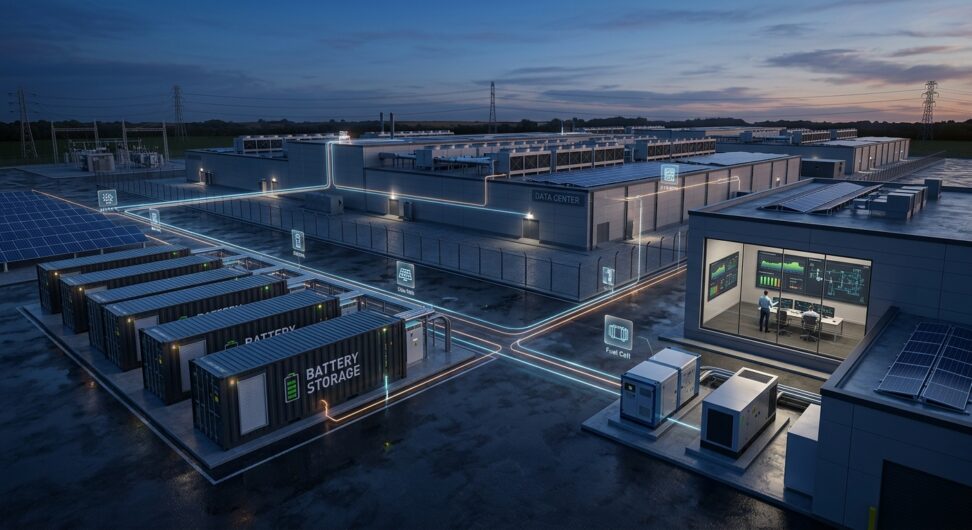
Distributed Energy Solutions Powering AI’s Growing Electricity Demand
Data centers supporting artificial intelligence workloads are consuming electricity at a pace that traditional grid infrastructure struggles to match. As hyperscale computing facilities multiply across the United States, utilities and developers are turning to distributed energy resources as a faster path to meeting this demand than waiting years for new transmission lines and large power plants to come online.
The Scale of AI’s Energy Appetite
Large language model training and inference operations require massive, continuous power loads. A single hyperscale data center campus can demand hundreds of megawatts, rivaling the electricity consumption of a mid-sized city. Industry forecasts suggest data center electricity demand in the U.S. could double or even triple by the early 2030s, driven largely by AI applications.
Traditional solutions, such as building new natural gas plants or expanding transmission infrastructure, typically take five to ten years to complete when accounting for permitting, interconnection queues, and construction timelines. AI developers, however, need power far sooner, often within 12 to 24 months of announcing a new facility.
Why Distributed Energy Is Gaining Traction
Distributed energy resources, which include on-site solar, battery storage, fuel cells, and small-scale generation located near the point of consumption, offer a quicker alternative to conventional grid expansion. These systems can be deployed in months rather than years, making them attractive for data center operators racing to bring compute capacity online.
- Faster deployment timelines compared to utility-scale generation and transmission projects
- Reduced strain on existing grid infrastructure during peak demand periods
- Greater energy reliability through localized backup power
- Flexibility to scale capacity incrementally as computing needs grow
- Potential cost savings by avoiding lengthy interconnection queue delays
Battery Storage and On-Site Generation
Battery energy storage systems are playing a central role in bridging the gap between data center power needs and grid availability. These systems allow facilities to store electricity during off-peak hours and discharge it during periods of high demand, smoothing out consumption patterns that would otherwise strain local grids.
Some data center developers are also pairing on-site natural gas generation or fuel cells with renewable sources to create hybrid power systems. This approach provides the reliability needed for continuous AI operations while incorporating cleaner energy where feasible. Companies like Bloom Energy, a California-based manufacturer of solid oxide fuel cell systems, have positioned their technology as a bridge solution for data centers seeking rapid, on-site power generation without waiting for grid upgrades.
Utilities Adapting Their Approach
Electric utilities across the country are reassessing how they plan for and accommodate large new loads. Some are exploring flexible interconnection agreements that allow data centers to connect to the grid sooner in exchange for accepting curtailment during periods of peak system stress. Others are investing directly in distributed generation and storage projects located near major data center clusters in states such as Virginia, Texas, and Ohio, which have emerged as hubs for data center construction.
Virginia’s Loudoun County, often referred to as “Data Center Alley,” has become a focal point for these discussions given its concentration of facilities and the resulting pressure on local grid capacity. Utilities serving the region are examining distributed energy options alongside traditional infrastructure upgrades to keep pace with new connection requests.
Behind-the-Meter Solutions
Behind-the-meter energy systems, where generation and storage are installed directly at the data center site rather than relying solely on grid-supplied power, are becoming more common. This model allows operators to maintain greater control over their energy supply and reduce dependence on utility infrastructure that may not be ready to support their load growth timeline.
Microgrids, which can operate independently from the main grid when needed, are also being explored by some data center operators as a way to ensure uninterrupted power for AI training clusters that cannot tolerate outages without significant financial and operational consequences.
Looking Ahead
The convergence of distributed energy technology and AI infrastructure demand is reshaping how power systems are planned and built in the United States. While large-scale grid investments remain necessary for long-term capacity needs, distributed energy resources are filling an immediate gap that traditional infrastructure development cannot address quickly enough.
As AI adoption continues to expand across industries, the pressure on electricity infrastructure is likely to intensify further. Distributed energy solutions, combined with evolving utility strategies and flexible interconnection models, are emerging as practical tools to keep pace with this demand while broader grid modernization efforts proceed on a longer timeline.
Analyzed and outlined by Claude Sonnet 5, images by Gemini 3.1 Flash.
**Source** https://www.renewableenergyworld.com/power-grid/distribution/distributed-energy-is-the-fastest-fix-for-ais-power-crunch/