
Filipino Renewable Energy Innovations Transform Off-Grid Power Solutions
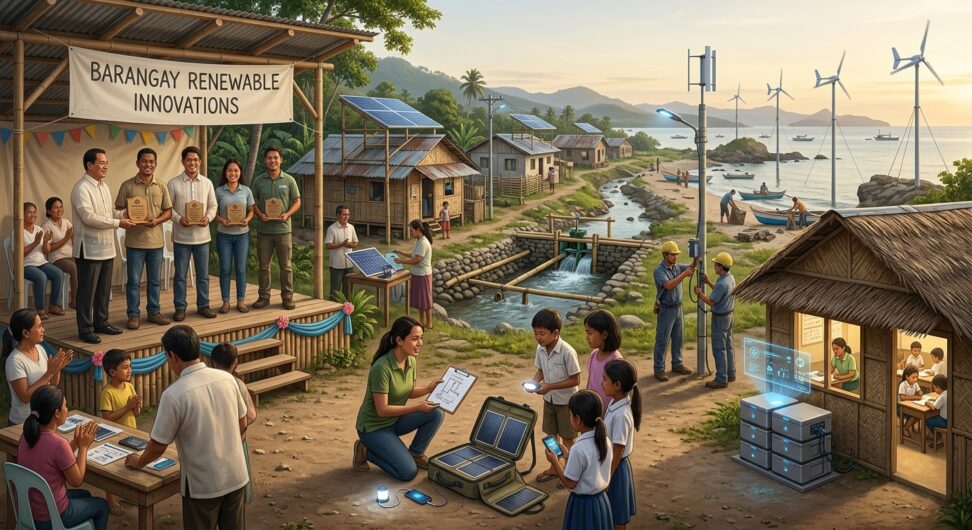
The Philippines has recognized five homegrown innovations that address one of the country’s most persistent challenges: reliable access to electricity in remote and underserved communities. President Ferdinand Marcos Jr. honored these projects in a national competition celebrating local ingenuity in addressing energy access gaps across the archipelago.
The Philippines, made up of more than 7,000 islands, has long struggled with extending its power grid to isolated communities. Mountainous terrain, scattered island geography, and the high cost of traditional grid infrastructure have left many barangays without consistent electricity. These conditions have pushed local inventors and engineers to develop practical, low-cost renewable energy alternatives suited to the country’s unique geography.
Recognizing Local Innovation
The national competition served as a platform to spotlight Filipino inventors who have developed renewable energy technologies specifically designed for off-grid applications. Rather than importing foreign solutions, these innovators built systems using locally available materials and designs tailored to the needs of rural and island communities.
The recognition ceremony highlighted how homegrown solutions can be more cost-effective and practical than imported technologies, particularly when adapted to local weather patterns, terrain, and community resources.
Solar-Powered Solutions for Remote Barangays
Several of the honored innovations centered on solar energy, harnessing the Philippines’ abundant sunlight to power homes, schools, and small businesses in areas the national grid has yet to reach. These systems were designed with simplicity and affordability in mind, allowing communities with limited technical expertise to install, operate, and maintain them without heavy reliance on outside support.
Solar micro-grids and portable solar units featured prominently among the winning entries, offering scalable options that can serve individual households or entire barangays depending on need and available funding.
Harnessing Water and Wind Resources
Beyond solar technology, the competition also recognized innovations that tap into the country’s water and wind resources. Micro-hydro systems designed for small rivers and streams common in rural provinces offer another pathway to electrification, particularly in mountainous regions where sunlight may be less consistent due to cloud cover.
Wind-based innovations were also part of the honored projects, taking advantage of the Philippines’ coastal geography and seasonal wind patterns to generate supplementary power for communities near shorelines.
Addressing the Off-Grid Challenge
According to government data, thousands of households across the Philippines remain without access to reliable electricity, particularly in Mindanao, parts of the Visayas, and remote areas of Luzon. Traditional grid extension projects are often expensive and slow to implement given the archipelago’s geography, making decentralized renewable energy systems an increasingly attractive alternative.
The innovations honored in this competition reflect a broader shift in the country’s energy strategy, one that emphasizes localized, community-based power generation rather than relying solely on centralized grid expansion.
Government Support for Renewable Energy Development
The recognition ceremony underscores the government’s stated commitment to supporting local innovation as a means of achieving broader energy access goals. By publicly honoring these inventors, the administration signals its intent to encourage further research, development, and eventual commercialization of similar technologies.
This kind of national recognition can also serve practical purposes beyond ceremony, potentially opening doors to funding opportunities, partnerships with private industry, and support from government agencies tasked with rural electrification.
What This Means for Renewable Energy in the Philippines
The honored innovations point to a growing ecosystem of local expertise in renewable energy technology within the Philippines. As the country continues to pursue its renewable energy targets, homegrown solutions like these could play an increasingly important role in complementing large-scale solar and wind farm projects.
Key takeaways from this development include:
- Local innovators are developing renewable energy systems tailored specifically to Philippine geography and community needs
- Solar, micro-hydro, and wind technologies were all represented among the honored innovations
- Off-grid solutions offer a practical alternative to costly and slow traditional grid extension projects
- Government recognition may pave the way for further investment and support in local renewable energy research
- These innovations address longstanding electrification gaps in remote and island communities
As the Philippines continues to navigate the challenges of extending reliable power to its scattered island communities, recognitions like this national competition highlight a path forward built on local knowledge and innovation. Rather than waiting for grid infrastructure to catch up, communities and inventors are creating their own solutions, one barangay at a time.
The success of these projects may also inspire other developing nations facing similar geographic and infrastructure challenges to look toward decentralized, locally developed renewable energy systems as a viable path to universal electrification.
Analyzed and outlined by Claude Sonnet 5, images by Gemini 3.1 Flash
**Source** https://canadianinquirer.net/2026/09/04/marcos-honors-5-filipino-innovations-in-national-competition/