
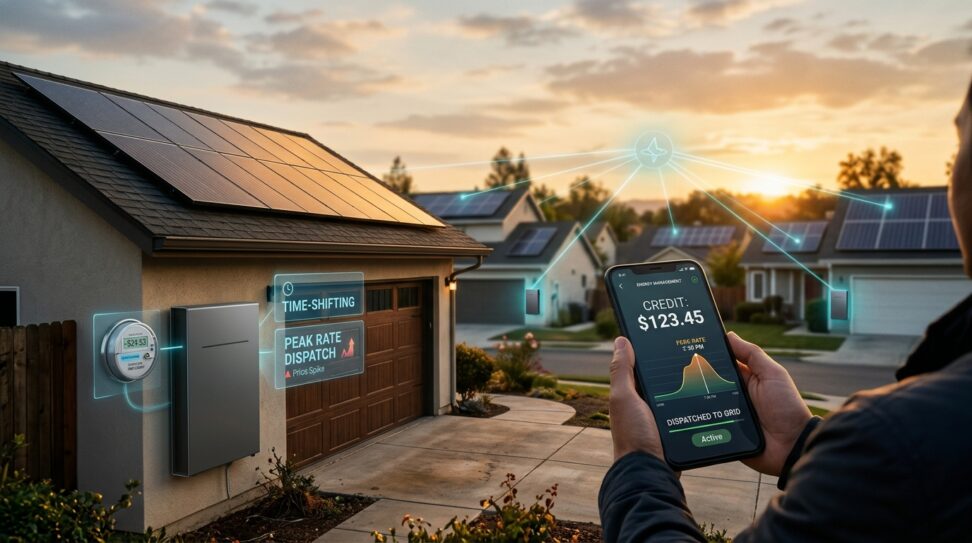
How Residential Solar Batteries Create Reverse Electric Bills
Homeowners across various markets are discovering a new financial reality: instead of paying utility companies each month, they are receiving payments from them. This shift is being driven by the growing adoption of residential solar battery systems, which allow households to store excess solar energy and sell it back to the grid during periods of high demand.
The Mechanics Behind the Reverse Bill
Traditional solar setups allow homeowners to generate electricity during daylight hours and feed excess power back into the grid, often earning modest credits through net metering programs. Battery storage systems change this equation significantly. Instead of immediately exporting all excess solar generation, homeowners can store that energy in batteries and choose when to sell it back to the grid, typically timing sales to coincide with peak demand periods when electricity prices are highest.
This strategy, often called “time-shifting,” lets households capture significantly higher value for their stored energy. During evening hours when solar generation drops but electricity demand rises, homeowners with battery systems can discharge stored power back into the grid at premium rates, sometimes generating enough credit to offset their entire electricity bill and then some.
Virtual Power Plants Driving the Trend
A major factor enabling these reverse bills is the rise of virtual power plant (VPP) programs. These programs aggregate thousands of individual home battery systems into a single, coordinated network that utility companies can call upon during periods of grid stress, such as heat waves or unexpected demand spikes.
Utilities and energy companies compensate participating homeowners for the electricity their batteries contribute during these events, often at rates well above standard retail electricity prices. Some programs offer both upfront incentives for enrollment and ongoing payments based on actual energy discharged during grid events.
- Homeowners maintain control over their battery systems while participating
- Payments can arrive as bill credits or direct cash compensation
- Grid operators benefit from reduced strain during peak demand periods
- Participation typically requires compatible battery and inverter hardware
Real-World Financial Impact
The financial outcomes vary depending on system size, local electricity rates, and specific utility programs, but some homeowners are reporting quarterly or monthly bills that show a credit balance rather than an amount owed. This is a notable shift from the traditional model where solar owners simply reduced their bills to near zero.
Battery storage capacity has also become more affordable and efficient in recent years, making these systems accessible to a broader range of homeowners. Improved battery chemistry, particularly lithium iron phosphate (LFP) technology, has extended battery lifespan and reduced degradation, making the long-term economics of these systems more favorable.
Key Players in the Battery Storage Market
Several companies have positioned themselves at the center of this shift toward residential energy storage and VPP participation.
Tesla, the electric vehicle and clean energy company founded by Elon Musk, produces the Powerwall home battery system and operates its own VPP program in select markets, allowing homeowners to enroll their Powerwalls in grid-support initiatives.
Sunrun, a residential solar and battery storage provider based in San Francisco, has built out extensive VPP partnerships with utilities across the United States, connecting its customer base of solar-battery households into coordinated grid resources.
Enphase Energy, headquartered in Fremont, California, manufactures microinverters and battery storage systems and has expanded its software platform to support energy management and grid services participation for homeowners.
Utility Companies Adapting Their Models
As more households adopt battery storage, utility companies are being forced to rethink rate structures and demand management strategies. Some utilities have introduced specific tariffs or compensation structures designed to encourage battery adoption, recognizing that distributed storage can reduce the need for costly infrastructure upgrades and new power plant construction.
Regulatory bodies in various states and countries are also examining how to fairly compensate homeowners for the grid services their batteries provide, while ensuring utilities can maintain reliable service for all customers, including those without solar or battery systems.
What This Means for Future Homeowners
The trend toward reverse electric bills signals a broader transformation in how residential energy systems function within the larger grid. Rather than being passive consumers, homeowners with solar batteries are becoming active participants in energy markets, with the ability to generate income from their systems beyond simple bill reduction.
For homeowners considering solar battery investments, understanding local VPP program availability, utility compensation rates, and the specific hardware requirements for participation will be increasingly important factors in maximizing the financial return on these systems. As battery costs continue to decline and more utilities roll out grid-support programs, the possibility of a reverse electric bill may become more common across various regions.
Analyzed and outlined by Claude Sonnet 5, images by Gemini 3.1 Flash.
**Source** https://news.sbs.co.kr/english/article.do?news_id=N1008715039