
Large Battery Storage Powers New York Residential Buildings Safely
New York City is moving forward with large-scale battery storage installations in residential buildings, marking a shift in how urban apartment complexes manage energy needs while addressing long-standing safety concerns around lithium-ion technology.
The push toward integrating battery energy storage systems (BESS) into multifamily residential buildings comes as the city works to meet aggressive climate targets while easing strain on an aging power grid. These installations allow buildings to store electricity during off-peak hours or from renewable sources, then draw on that stored power during periods of high demand.
Addressing Safety Concerns Head-On
Battery storage systems, particularly those using lithium-ion chemistry, have faced public scrutiny following incidents involving smaller consumer batteries, including e-bike fires that have plagued New York City in recent years. Industry experts and city officials have worked to distinguish these large-scale, professionally engineered systems from the smaller, often improperly manufactured batteries responsible for past incidents.
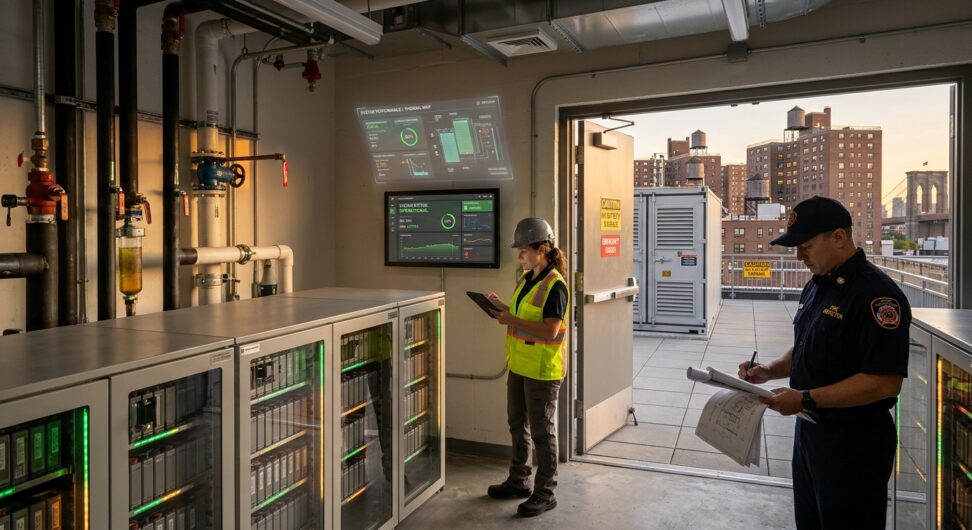
Large commercial and residential battery installations undergo a different level of scrutiny compared to consumer electronics. These systems typically include:
- Advanced thermal management systems to prevent overheating
- Fire suppression technology built directly into battery enclosures
- Continuous monitoring software that detects irregularities before they escalate
- Physical separation and ventilation requirements mandated by local fire codes
- Regular inspection protocols overseen by city agencies
The Fire Department of New York (FDNY) has been closely involved in developing and enforcing safety standards for these installations, working alongside the Department of Buildings to ensure that battery systems in residential settings meet rigorous codes before they are approved for use.
Why New York Buildings Are Adopting Battery Storage
The motivation behind this shift extends beyond simple energy management. New York State has set ambitious goals under the Climate Leadership and Community Protection Act, aiming for a significant reduction in greenhouse gas emissions and a transition toward renewable energy sources over the coming decades.
For residential buildings, battery storage offers practical benefits beyond emissions reductions. By storing energy during periods of lower electricity costs and deploying it during peak demand, building owners can reduce utility expenses. Additionally, battery systems provide backup power during outages, a increasingly valuable feature as extreme weather events become more frequent.
Large apartment complexes and residential towers are particularly well-suited for these installations because they have the physical space and electrical infrastructure to accommodate sizable battery systems, unlike single-family homes with more limited capacity.
Regulatory Framework and Oversight
New York City has developed specific guidelines governing where and how battery storage systems can be installed in residential buildings. These regulations address placement, capacity limits, ventilation requirements, and emergency response protocols.
City officials have emphasized that the regulatory approach draws on lessons learned from the broader deployment of battery technology across the five boroughs, including utility-scale projects that have already been operating for several years. This experience has informed stricter guidelines for residential applications, where proximity to living spaces raises the stakes for safety compliance.
Building owners seeking to install battery storage must work with certified installers and submit detailed plans to city agencies before receiving approval. This process includes reviews of electrical systems, structural considerations, and emergency egress routes to ensure that battery installations do not compromise existing safety measures.
Looking Ahead
As more residential buildings across New York City adopt battery storage technology, the trend reflects a broader national movement toward decentralized energy systems that can operate independently of, or in coordination with, traditional power grids. This approach, often referred to as distributed energy resources, allows individual buildings to contribute to overall grid stability while reducing their own carbon footprint.
Industry analysts expect continued growth in residential battery storage installations throughout the city as technology costs decline and safety track records continue to build public confidence. The success of current installations will likely influence how quickly other buildings move to adopt similar systems, particularly as New York State continues to push forward with its clean energy transition goals.
For residents living in buildings equipped with these systems, the technology operates largely behind the scenes, providing reliable power management without requiring direct interaction from tenants. The real impact comes through more stable electricity costs, backup power reliability during outages, and a smaller collective carbon footprint for the building as a whole.
As New York continues to navigate the balance between rapid clean energy adoption and public safety, the current wave of residential battery storage installations will serve as a meaningful test case for how dense urban environments can integrate advanced energy technology responsibly.
Analyzed and outlined by Claude Sonnet 5, images by Gemini 3.1 Flash.
**Source**
Can larger batteries safely power residential buildings? A project in New York aims to show how