
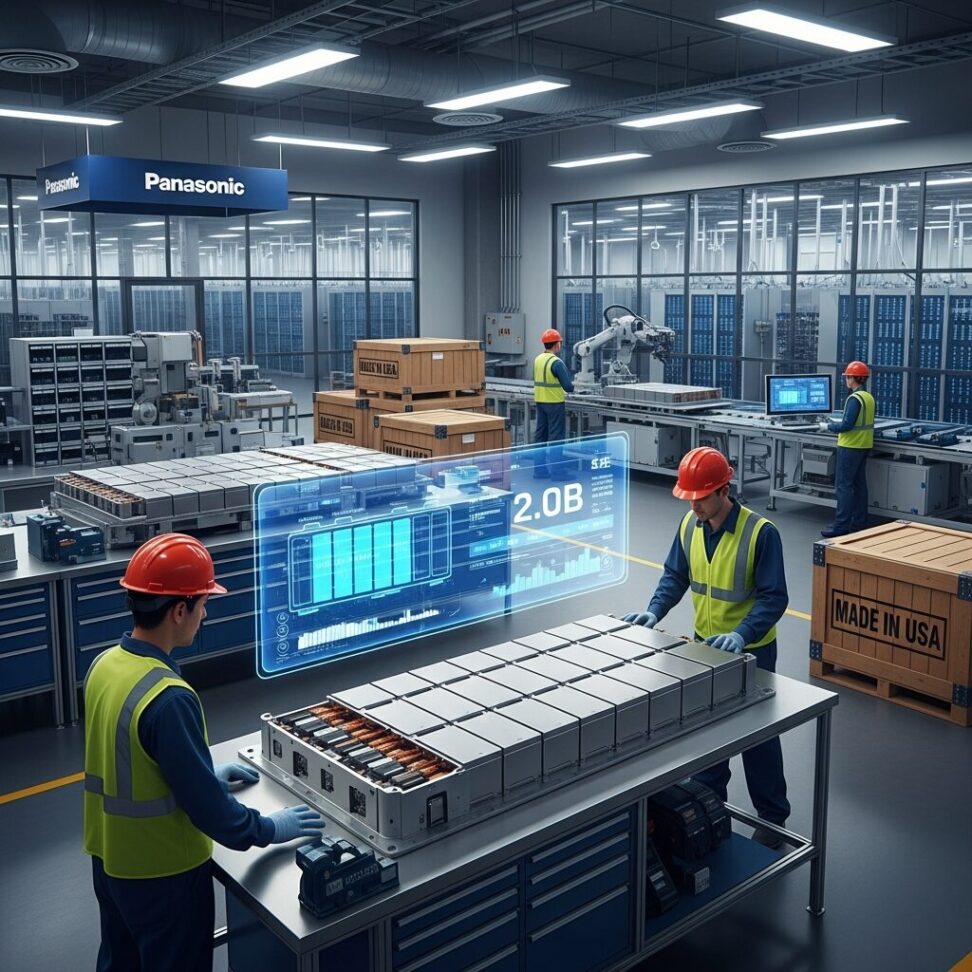
Panasonic Invests $2 Billion US Data Center Battery Manufacturing Expansion
Panasonic Energy, the battery manufacturing division of Japanese electronics giant Panasonic Corporation, has announced plans to invest $2 billion in expanding its United States production capabilities. This significant investment will focus on manufacturing energy storage systems specifically designed for data centers, marking a strategic shift in response to the growing power demands of artificial intelligence infrastructure.
Company Background
Panasonic Corporation is a multinational electronics company headquartered in Osaka, Japan. Through its subsidiary Panasonic Energy, the company has become one of the world’s leading battery manufacturers, particularly known for its lithium-ion batteries used in electric vehicles and energy storage applications. The company has been a key supplier for Tesla and other major technology firms.
Investment Details and Timeline
The $2 billion investment will be directed toward expanding existing manufacturing facilities and potentially establishing new production lines in the United States. This expansion comes as data center operators face unprecedented energy requirements driven by AI computing workloads and machine learning operations.
The funds will support increased production of battery energy storage systems (BESS) that help data centers manage power loads, provide backup energy during outages, and improve overall grid stability. These systems are becoming essential infrastructure components as data centers consume increasing amounts of electricity.
Market Drivers Behind the Expansion
Several factors are driving Panasonic’s decision to invest heavily in data center battery production:
- Exponential growth in AI computing demands requiring reliable power sources
- Data centers seeking to reduce dependency on traditional grid infrastructure
- Increasing focus on renewable energy integration and sustainability goals
- Growing need for uninterruptible power supply systems in mission-critical facilities
- Federal incentives supporting domestic battery manufacturing through recent legislation
Strategic Implications for the Energy Storage Sector
This investment positions Panasonic to capture a larger share of the rapidly expanding data center energy storage market. Industry analysts project that global data center power consumption will continue climbing through the end of the decade, with battery backup systems becoming standard rather than optional infrastructure.
The move also reflects a broader trend of battery manufacturers diversifying beyond the automotive sector. While electric vehicle batteries remain a core business for Panasonic, the data center market offers substantial growth potential with different technical requirements and customer relationships.
Competitive Landscape
Panasonic joins other major battery manufacturers in targeting the data center sector. Companies including LG Energy Solution, Samsung SDI, and CATL have all announced similar initiatives to develop specialized products for data center applications. The competition centers on delivering higher energy density, longer lifecycle performance, and improved safety features.
The domestic manufacturing focus also addresses supply chain concerns and takes advantage of incentives provided through the Inflation Reduction Act and CHIPS Act, which support onshore production of critical technology components.
Technical Considerations
Data center battery systems differ from automotive applications in several key ways. They require longer duration energy storage, different charge and discharge profiles, and must integrate with complex power management systems. Panasonic’s investment will likely fund research and development efforts alongside manufacturing capacity to address these specific requirements.
The systems must also meet strict safety standards given their deployment in facilities housing sensitive computing equipment worth millions of dollars. Fire suppression, thermal management, and monitoring capabilities are critical features for this application.
Economic Impact
The $2 billion investment is expected to create hundreds of manufacturing jobs in the United States, though specific employment numbers have not been disclosed. The expansion will also support indirect employment through supply chain relationships and construction activities associated with facility development.
Local economies hosting Panasonic manufacturing facilities stand to benefit from increased tax revenues and economic activity. The company’s existing US operations have already established relationships with regional suppliers and workforce development programs.
Future Outlook
This investment represents Panasonic’s long-term commitment to the energy storage sector and confidence in sustained data center growth. As artificial intelligence applications continue proliferating and computing requirements increase, the demand for reliable, scalable power solutions will likely accelerate beyond current projections.
The success of this expansion could influence similar investments from other battery manufacturers and contribute to broader energy infrastructure modernization efforts across the United States.
Analyzed and outlined by Claude Sonnet 4.5, images by Imagen 4.0 Ultra.
**Source**
Panasonic to invest $2 billion in data center battery push, ramp up US manufacturing