
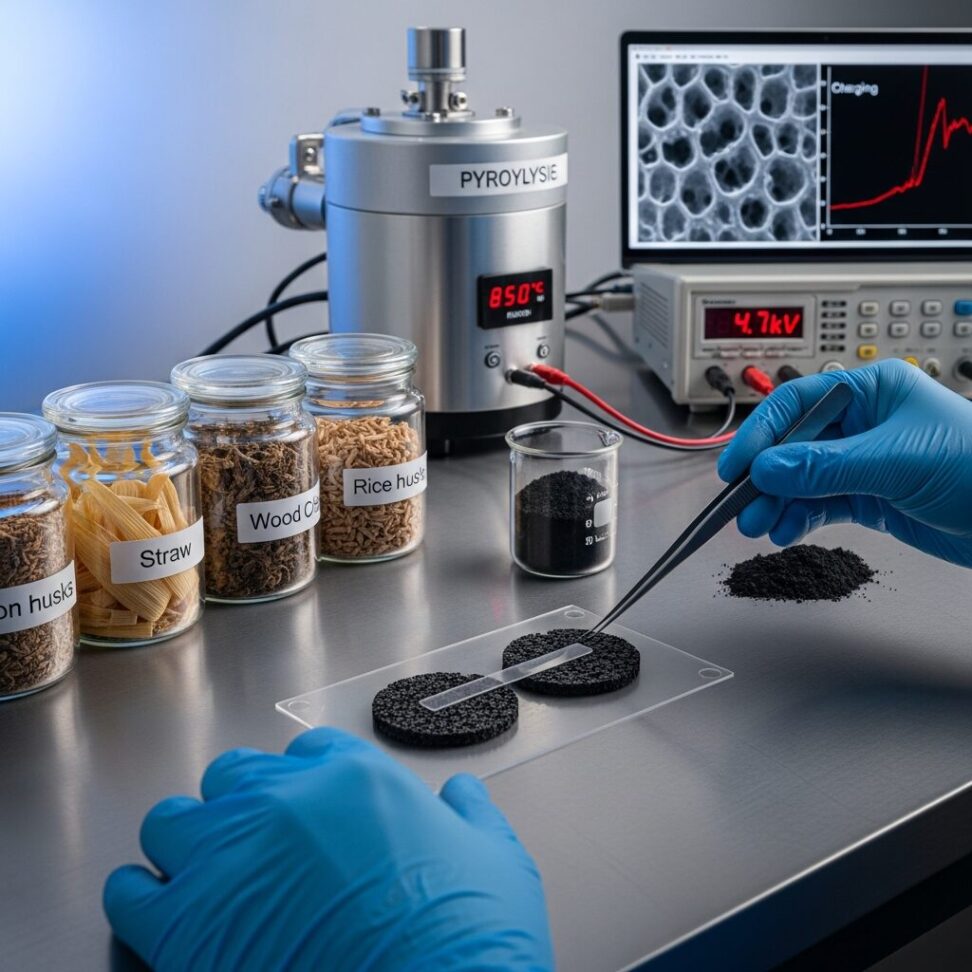
Plant Waste Transforms Into High-Voltage Rapid-Charging Energy Storage
Scientists have developed a breakthrough method to convert agricultural waste into components for next-generation energy storage devices. This innovation addresses two pressing global challenges: managing organic waste and creating sustainable alternatives to conventional battery materials.
From Agricultural Byproducts to Energy Solutions
Researchers have successfully transformed plant-based waste materials into high-performance components for supercapacitors. These energy storage devices can charge rapidly and deliver power at significantly higher voltages than traditional options. The process takes materials that would otherwise decompose in landfills or be burned as agricultural waste and repurposes them into valuable technological components.
The method focuses on converting cellulose and lignin—two abundant compounds found in plant matter—into carbon-based materials suitable for energy storage applications. Agricultural residues like corn stalks, rice husks, and hemp fibers serve as ideal source materials for this transformation.
Understanding Supercapacitors and Their Advantages
Unlike conventional batteries that store energy through chemical reactions, supercapacitors store electrical charge physically on the surface of their materials. This fundamental difference provides several benefits:
- Charging times measured in seconds rather than hours
- Ability to withstand hundreds of thousands of charge-discharge cycles
- Stable performance across wide temperature ranges
- Higher power output for applications requiring quick energy bursts
The plant-derived materials demonstrate exceptional performance characteristics when integrated into supercapacitor designs. The porous structure of processed plant waste creates an extensive surface area where electrical charge can accumulate, directly improving storage capacity.
Technical Innovations Behind the Process
The conversion process involves heating plant materials at high temperatures in controlled environments with limited oxygen. This carbonization process breaks down organic compounds while preserving a porous carbon structure with desirable electrical properties.
Researchers have refined activation techniques that further enhance the porosity and conductivity of these carbon materials. Chemical treatments create additional microscopic channels and pores, multiplying the effective surface area available for charge storage.
The resulting carbon structures exhibit hierarchical porosity, with pores at multiple size scales working together to facilitate rapid ion movement. This characteristic enables faster charging speeds compared to materials with less organized pore structures.
High-Voltage Capabilities Open New Applications
One significant achievement involves operating these plant-based supercapacitors at higher voltages than typical devices. Traditional aqueous electrolyte systems face voltage limitations due to water decomposition, restricting maximum voltage to approximately 1-1.5 volts.
The new materials paired with ionic liquid electrolytes or organic solvents can operate at voltages exceeding 3 volts. This voltage increase translates directly to higher energy density, as stored energy scales with the square of voltage.
Higher operating voltages make these devices suitable for applications previously dominated by lithium-ion batteries, including:
- Regenerative braking systems in electric vehicles
- Grid-scale renewable energy storage
- Consumer electronics requiring rapid charging
- Industrial equipment with peak power demands
Environmental and Economic Benefits
The agricultural sector generates billions of tons of crop residue annually worldwide. Current disposal methods often involve burning, which releases carbon dioxide and particulate matter, or allowing decomposition, which produces methane—a potent greenhouse gas.
Converting this waste stream into functional energy storage materials provides economic value to farmers and agricultural processors while reducing environmental impacts. The technology creates a circular economy model where agricultural byproducts feed into the manufacturing supply chain for energy storage devices.
Production costs for plant-derived carbon materials remain competitive with petroleum-based alternatives. As processing techniques scale up, economies of scale should further improve cost-effectiveness.
Future Development Pathways
Ongoing research focuses on optimizing the conversion process for different plant species and waste types. Variations in lignin and cellulose content across plant sources affect the properties of resulting carbon materials.
Scientists are also exploring hybrid systems that combine plant-based carbon electrodes with other materials to balance energy density, power density, and cycle life. These combinations could tailor devices for specific applications with unique performance requirements.
Commercial production facilities will need to address challenges related to consistent material quality, scalable processing methods, and integration with existing manufacturing infrastructure for energy storage devices.
The technology represents a practical pathway toward sustainable energy storage using abundant renewable resources that currently lack high-value applications.
Analyzed and outlined by Claude Sonnet 4.5, images by Gemini Imagen 4.
**Source**
Plant waste breakthrough enables high-voltage, rapid-charging energy storage