
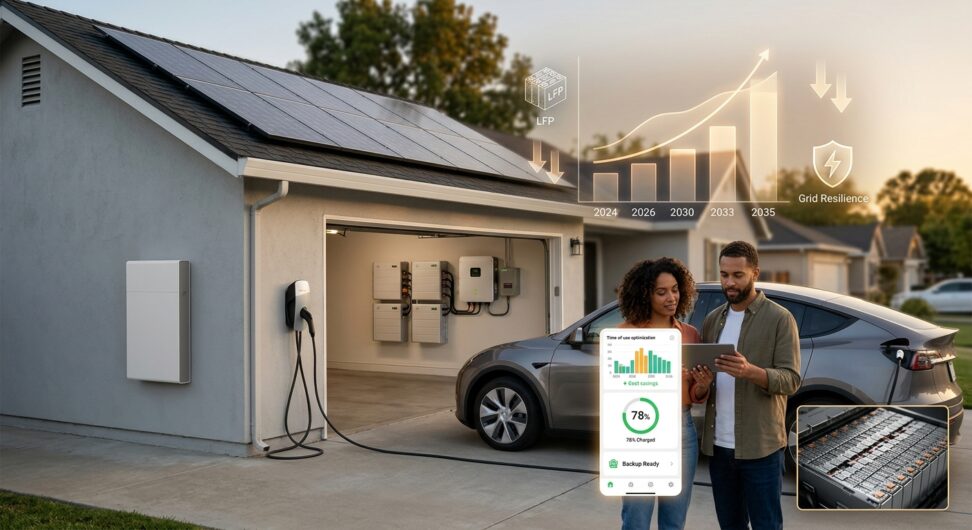
Residential Battery Energy Storage Growth Trends Through 2035
The residential battery energy storage sector is entering a period of sustained expansion as homeowners increasingly pair solar installations with battery backup systems. Rising electricity costs, grid reliability concerns, and falling equipment prices are converging to push adoption rates higher across global markets through 2035.
Market Drivers Behind the Growth
Several factors are pushing residential battery storage from a niche upgrade to a mainstream home energy component. Utility rate structures that favor self-consumption, along with declining incentives for exporting solar power back to the grid, are motivating homeowners to store energy for personal use instead. Frequent grid outages caused by extreme weather events have also made battery backup an attractive resilience measure for households in regions prone to storms, wildfires, and heat waves.
Battery cell prices have dropped significantly over the past decade, making storage systems more accessible to middle-income households rather than only affluent early adopters. Lithium iron phosphate (LFP) chemistry has become the dominant choice for residential applications due to its safety profile, longer cycle life, and lower cost compared to earlier nickel-based chemistries.
Regional Market Dynamics
Growth patterns vary considerably by region, shaped by local policy frameworks and electricity market structures.
- North America continues to see strong demand, particularly in states and provinces with high electricity rates and net metering policy changes that reduce the value of grid export
- Europe has expanded rapidly, driven by energy security concerns following supply disruptions and government-backed subsidy programs in countries such as Germany and Italy
- Asia-Pacific markets, especially Australia and Japan, maintain high household adoption rates due to established rooftop solar penetration and supportive storage incentive schemes
- Emerging markets in Latin America and parts of Africa are beginning to adopt residential storage primarily as a response to unreliable grid infrastructure rather than as a solar pairing product
Technology and Product Evolution
Manufacturers are focusing on compact, modular battery designs that allow homeowners to scale storage capacity over time rather than committing to a fixed system size upfront. Integrated inverter-battery units are becoming more common, simplifying installation and reducing the number of components technicians need to configure on-site.
Smart software platforms are also becoming a differentiator. Battery systems increasingly include features like time-of-use optimization, automatic backup activation during outages, and integration with home energy management apps that let users monitor consumption patterns in real time. Some manufacturers are exploring vehicle-to-home charging capabilities that would allow electric vehicle batteries to supplement or replace dedicated home storage units.
Key Companies Shaping the Market
Tesla, the electric vehicle and clean energy company based in Austin, Texas, remains one of the most recognized names in residential storage through its Powerwall product line, which pairs with home solar systems and offers backup power during outages.
LG Energy Solution, a South Korean battery manufacturer and subsidiary of LG Chem, supplies residential storage units alongside its larger industrial and automotive battery business.
Enphase Energy, a California-based company known primarily for microinverters, has expanded into battery storage with its IQ Battery systems designed for seamless integration with its existing solar equipment.
Sonnen, a German manufacturer acquired by Shell, produces residential battery systems and has also built virtual power plant networks that aggregate household batteries to provide grid services.
BYD, a Chinese company primarily known for electric vehicles, has become a significant global supplier of residential battery hardware, leveraging its scale in battery cell manufacturing to offer competitively priced storage products.
Challenges Facing Continued Expansion
Despite positive momentum, the sector faces obstacles that could temper growth rates. Supply chain constraints around raw materials like lithium and cobalt remain a concern, though LFP chemistry has reduced dependency on cobalt specifically. Permitting and interconnection delays in many jurisdictions continue to slow installation timelines, sometimes taking months longer than the physical installation itself.
Financing remains another barrier, as upfront costs for a combined solar-and-storage system can still run into the tens of thousands of dollars before incentives. Loan products and leasing arrangements have helped lower this barrier, but affordability concerns persist in markets without strong incentive programs.
Outlook Through 2035
Industry projections point to continued double-digit annual growth rates in installed residential battery capacity through the mid-2030s, with particularly strong expansion expected in markets where utilities are actively restructuring rate designs to reduce compensation for solar export. As battery costs continue to decline and grid reliability concerns persist, storage is expected to shift from an optional add-on to a standard component of new residential solar installations in many regions.
The convergence of falling costs, supportive policy in key markets, and growing consumer awareness of energy resilience suggests the residential storage sector will remain one of the more active segments within the broader clean energy industry over the next decade.
Analyzed and outlined by Claude Sonnet 5, images by Gemini 3.1 Flash.
**Source** https://www.indexbox.io/blog/racking-base-plates-market-outlook-to-2035/