
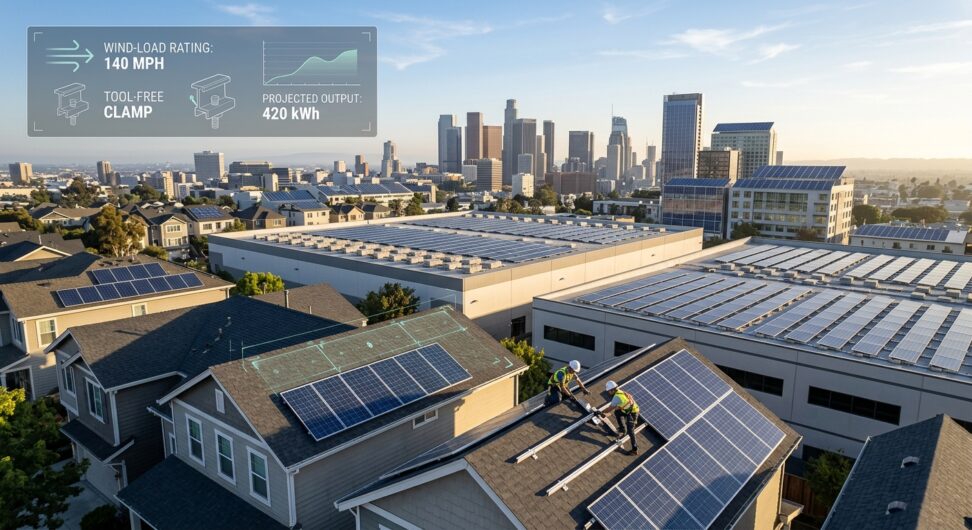
Roof Mounted Solar Racking Systems Drive 2035 Market Growth
The global market for roof mounted solar racking systems is positioned for sustained expansion through 2035, driven by accelerating rooftop photovoltaic (PV) installations across residential, commercial, and industrial sectors. As property owners and businesses increasingly turn to on-site solar generation to reduce energy costs and carbon footprints, the demand for reliable mounting infrastructure that secures solar panels to rooftops has grown in parallel.
What Are Roof Mounted Solar Racking Systems
Roof mounted solar racking systems are structural frameworks designed to attach solar panels securely to various roof types, including flat, pitched, metal, and tile roofs. These systems must withstand wind loads, seismic activity, and weather exposure while allowing for proper panel orientation and airflow. Racking components typically include rails, clamps, brackets, and flashing designed to prevent roof penetration issues and water damage.
The racking system serves as a critical link between the solar array and the building structure, and its design directly impacts installation speed, system durability, and long-term maintenance costs.
Key Growth Drivers Through 2035
Several factors are converging to push this market forward over the coming decade:
- Rising adoption of rooftop solar in urban and suburban residential markets where land for ground-mounted systems is limited
- Expansion of commercial and industrial rooftop solar projects on warehouses, retail centers, and manufacturing facilities
- Government incentives, tax credits, and net metering policies that continue to support residential and commercial solar adoption
- Technological advancements in racking materials, including lightweight aluminum and corrosion-resistant alloys
- Growing emphasis on faster, tool-free installation methods that reduce labor costs
- Increasing focus on building-integrated photovoltaics (BIPV) that blend racking and roofing functions
Regional Market Trends
North America and Europe remain mature markets for rooftop solar racking, supported by established solar incentive programs and a growing base of homeowners seeking energy independence. In the United States, state-level policies and federal tax credits have encouraged steady residential solar growth, while commercial rooftop installations continue to rise across logistics and retail sectors.
Asia-Pacific is emerging as a significant growth region, with countries such as China, India, and Japan expanding rooftop solar capacity to meet rising electricity demand and reduce reliance on fossil fuels. Urbanization and industrial growth in these markets are creating substantial opportunities for racking system manufacturers.
Latin America and parts of the Middle East and Africa are also showing increased interest in rooftop solar, particularly in regions with high solar irradiance and unreliable grid infrastructure.
Segment Analysis: Flat Roof vs. Pitched Roof Systems
The market is generally segmented by roof type, with flat roof and pitched roof racking systems each serving distinct customer bases. Flat roof systems are common in commercial and industrial applications, often utilizing ballasted mounting designs that avoid roof penetrations. Pitched roof systems dominate the residential segment, relying on rail-based or rail-less designs anchored directly into roof structures.
Ballasted flat roof systems have gained popularity due to reduced installation complexity and lower risk of roof leaks, while pitched roof innovations have focused on reducing the number of components and improving aesthetic integration with existing roofing materials.
Material Innovation Shaping the Market
Manufacturers are increasingly focused on materials that balance strength, weight, and cost. Aluminum remains the dominant material choice due to its corrosion resistance and favorable strength-to-weight ratio. However, some manufacturers are exploring composite materials and coated steel options to reduce costs while maintaining structural integrity.
Durability testing against extreme weather events, including hurricanes and heavy snow loads, has become a priority for manufacturers seeking to meet stricter building codes in regions prone to severe weather.
Competitive Landscape
The roof mounted solar racking systems market includes a mix of established manufacturers and emerging players focused on innovation in installation efficiency and material science. Companies in this space typically compete on product durability, ease of installation, warranty terms, and compatibility with a wide range of panel types and roof structures.
Many manufacturers have expanded their product lines to include both residential and commercial racking solutions, along with software tools that assist installers with system design and permitting.
Challenges Facing the Industry
Despite positive growth projections, the industry faces certain challenges. Supply chain disruptions affecting aluminum and steel pricing can impact manufacturing costs. Additionally, varying building codes across regions require manufacturers to certify products for multiple jurisdictions, adding complexity to product development and market entry.
Labor shortages in the solar installation workforce have also prompted racking manufacturers to prioritize designs that reduce on-site assembly time, a trend expected to continue through 2035.
Outlook for the Market Through 2035
Industry projections indicate steady growth for roof mounted solar racking systems as rooftop solar continues to play a central role in global renewable energy strategies. As installation costs decline and public awareness of solar benefits increases, racking manufacturers are likely to see sustained demand across residential, commercial, and industrial rooftop segments worldwide.