
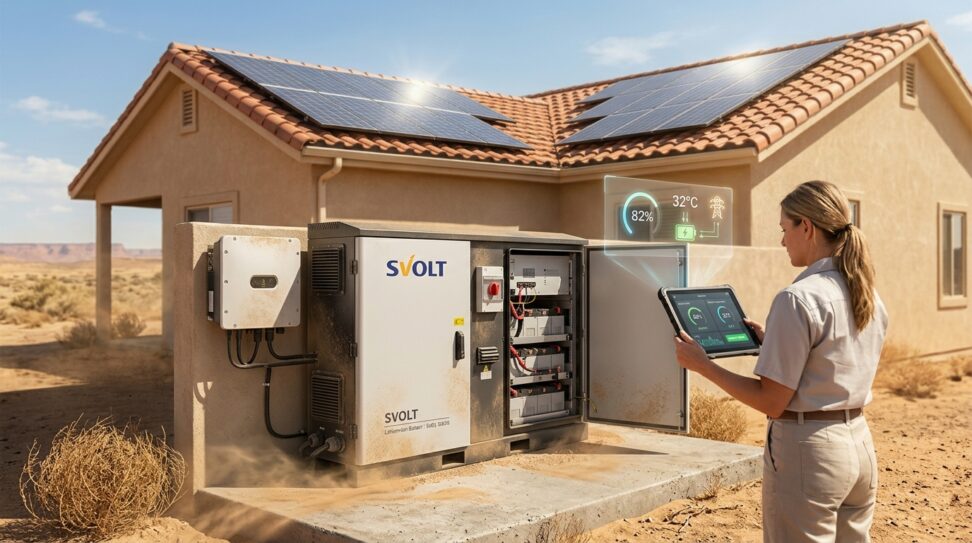
SVOLT Energy Desert-Ready Battery Solutions for North American Homes
Homeowners across the American Southwest face a unique set of challenges when it comes to energy storage. Extreme heat, dust exposure, and wide temperature swings can shorten the lifespan of standard battery systems and reduce their reliability during peak demand periods. SVOLT Energy has introduced a line of residential battery storage products engineered specifically to withstand these desert conditions, targeting homeowners in states such as Arizona, Nevada, California, and Texas.
Built for Extreme Climate Conditions
The new battery systems are designed to operate safely and efficiently in temperatures that regularly exceed 100°F, a condition common throughout much of the desert Southwest during summer months. Standard lithium-ion battery systems often require additional cooling infrastructure or experience accelerated degradation when exposed to sustained high heat. SVOLT’s desert-ready units incorporate thermal management systems intended to maintain stable internal operating temperatures without relying heavily on active cooling components that can fail or require frequent maintenance.
Dust and sand infiltration present another obstacle for outdoor-mounted equipment in arid regions. The company states its enclosures meet ingress protection standards suited for dusty, wind-prone environments, reducing the risk of particulate buildup affecting internal electronics.
Addressing Growing Demand in Solar-Heavy Markets
The desert Southwest has become one of the fastest-growing regions for residential solar adoption in North America, driven by high solar irradiance and rising electricity costs. As more households install rooftop solar systems, demand for compatible battery storage has grown alongside it, particularly among homeowners looking to maximize self-consumption of solar energy and maintain backup power during grid outages.
SVOLT’s product lineup is positioned to serve this expanding market by offering storage solutions that pair with existing residential solar installations. The battery systems are designed to support common use cases including:
- Backup power during grid outages, which are increasingly common during extreme heat events that strain regional power grids
- Time-of-use energy management, allowing homeowners to store solar energy generated during the day for use during evening peak pricing periods
- Off-grid or partial-grid applications for rural desert properties
Safety Considerations for High-Heat Environments
Battery safety becomes a heightened concern in regions where ambient temperatures already push equipment toward thermal limits. SVOLT has emphasized safety certifications and testing protocols for its residential product line, including measures aimed at preventing thermal runaway, a failure mode where a battery cell overheats and triggers a chain reaction affecting neighboring cells.
The company’s battery chemistry and cell design reportedly incorporate safeguards intended to isolate faults before they can spread, a feature particularly relevant for installations in hot climates where the margin for error is smaller than in temperate regions.
About SVOLT Energy
SVOLT Energy Technology is a battery manufacturer that develops lithium-ion battery cells, modules, and energy storage systems for both electric vehicles and stationary storage applications. Originally spun off from Great Wall Motor, the company has expanded its manufacturing footprint internationally and has been building out its presence in energy storage markets outside of China, including North America and Europe. SVOLT positions itself around battery safety innovation, including proprietary cell designs aimed at reducing fire risk in high-density battery packs.
Market Context and Availability
The introduction of climate-specific battery products reflects a broader trend in the energy storage industry, where manufacturers are increasingly tailoring designs to regional environmental conditions rather than offering one-size-fits-all solutions. Companies competing in the North American residential storage market have faced pressure to demonstrate durability in real-world conditions, particularly as extreme weather events become more frequent across the country.
For homeowners in desert regions, the practical benefits of climate-adapted storage include potentially longer battery lifespans, reduced maintenance requirements, and more consistent performance during the exact periods when backup power is most needed, such as heat waves that coincide with grid strain from air conditioning demand.
SVOLT has indicated it plans to work with regional installers and distributors to bring these battery systems to residential customers across desert markets in North America, though specific rollout timelines and pricing details for individual states have not been fully disclosed. The company’s broader strategy appears focused on establishing a foothold in the U.S. residential storage sector by addressing a specific regional pain point rather than competing solely on general performance metrics.
What This Means for Homeowners
For homeowners considering battery storage in hot, arid climates, the emergence of purpose-built products offers an additional option beyond general-purpose systems originally designed for more temperate markets. Prospective buyers should still evaluate factors such as warranty terms, local installer support, certification compliance, and integration compatibility with existing solar equipment before making a purchasing decision.
As extreme heat events become more frequent and grid reliability concerns grow in desert states, climate-specific engineering may become a more common consideration for residential energy storage buyers rather than a niche feature.
Analyzed and outlined by Claude Sonnet 5, images by Gemini 3.1 Flash.
**Source**
https://www.lelezard.com/en/news-22362773.html