
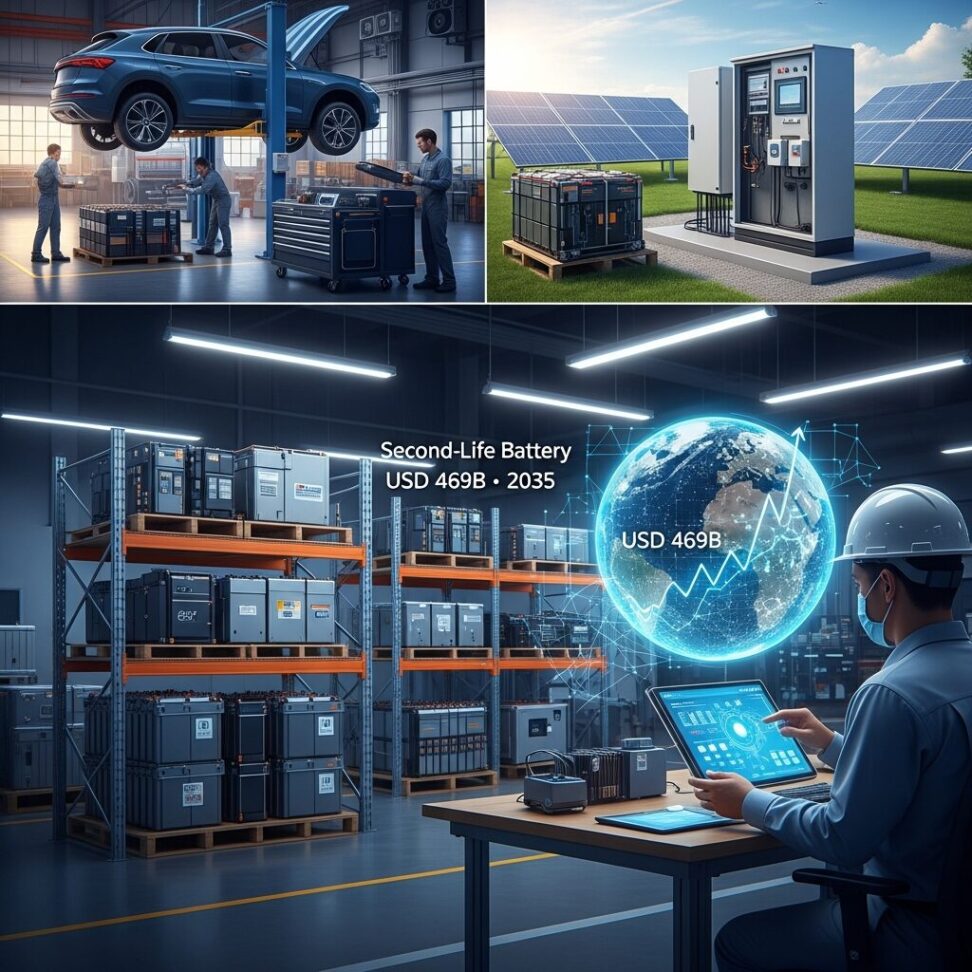
Second-Life Battery Market Growth: $46.9B Opportunity by 2030
The global second-life battery market is entering a period of rapid expansion, with projections indicating the sector could reach a valuation of USD 46.9 billion by 2030. This growth reflects the increasing volume of retired electric vehicle (EV) batteries and the rising demand for cost-effective energy storage solutions across residential, commercial, and industrial applications.
What Are Second-Life Batteries?
Second-life batteries are lithium-ion battery packs that have reached the end of their useful life in electric vehicles but still retain 70-80% of their original capacity. Rather than being sent directly to recycling facilities, these batteries are repurposed for less demanding applications such as stationary energy storage, backup power systems, and grid stabilization. This approach extends the useful life of battery materials by another 5 to 10 years, reducing waste and lowering the overall carbon footprint of battery production.
Key Drivers Behind Market Expansion
Several factors are fueling the accelerated growth of the second-life battery sector:
- Rising EV adoption globally is producing a growing supply of retired batteries entering the aftermarket
- Increasing demand for affordable energy storage systems to support renewable energy integration
- Government policies promoting circular economy practices and battery recycling mandates
- Cost advantages, with second-life batteries typically priced 30-70% lower than new battery systems
- Growing corporate sustainability commitments driving demand for greener storage solutions
Applications Driving Demand
Second-life batteries are finding use across a diverse range of applications. Grid-scale energy storage represents one of the largest use cases, helping utilities balance intermittent renewable energy sources like solar and wind. Commercial and industrial facilities are deploying these systems for peak shaving and demand charge management, while residential applications are expanding for home backup power and self-consumption of rooftop solar.
Telecommunications backup, EV charging station buffering, and off-grid electrification projects in developing regions are also emerging as significant market segments.
Regional Market Dynamics
Asia-Pacific is expected to dominate the second-life battery market through 2030, driven by China’s massive EV fleet and established battery manufacturing infrastructure. Europe follows closely, supported by stringent battery regulations including the EU Battery Regulation that took effect in 2023, which mandates battery recycling and repurposing standards. North America is also experiencing rapid growth, particularly in the United States, where investments in domestic battery supply chains are accelerating.
Challenges Facing the Industry
Despite promising growth projections, the second-life battery industry faces several hurdles. Battery testing and grading standards remain inconsistent across markets, making it difficult to accurately assess the remaining useful life of retired cells. Safety concerns around thermal runaway in aged batteries require specialized handling and monitoring systems. Additionally, the logistics of collecting, transporting, and processing used batteries at scale present operational and economic challenges.
Warranty issues and liability questions also complicate market development, as manufacturers and integrators work to establish clear standards for repurposed battery performance and safety.