
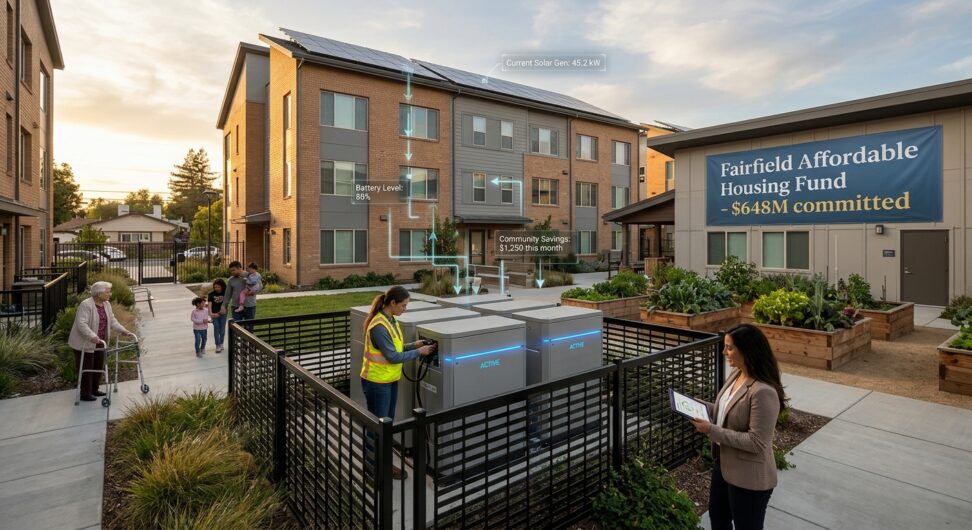
Fairfield’s $648M Affordable Housing Fund Advances Battery Energy Storage
Fairfield, a real estate investment management firm specializing in multifamily housing, has reached $648 million in commitments for its affordable housing fund, with a portion of the capital earmarked for battery energy storage systems across its property portfolio. The fund represents a growing trend in the real estate sector where affordable housing development and clean energy infrastructure are being combined into a single investment strategy.
Fund Details and Capital Commitments
The $648 million raised reflects strong investor appetite for assets that deliver both social impact and financial returns. Fairfield’s strategy centers on preserving and expanding affordable housing stock while integrating energy efficiency measures, including battery storage technology, into residential properties.
Battery energy storage systems allow property owners to store electricity generated from solar panels or drawn from the grid during off-peak hours, then deploy that power during periods of high demand. For affordable housing operators, this translates into lower utility costs, which can be passed on to residents, and reduced exposure to volatile energy prices.
Why Battery Storage Matters for Affordable Housing
Energy costs represent a significant burden for low and moderate income renters. By incorporating storage systems into building infrastructure, operators can:
- Reduce peak demand charges from utility providers
- Lower overall operating expenses for building owners
- Provide backup power during grid outages
- Support pairing with on-site solar generation
- Improve building resilience against extreme weather events
These benefits align with broader goals in the affordable housing sector, where operators face pressure to control costs without compromising housing quality or availability.
A Broader Industry Trend
Fairfield’s approach reflects a wider shift among institutional real estate investors who are increasingly viewing energy storage as a core component of property value rather than an optional add-on. As utility rates rise and grid reliability becomes a greater concern in many regions of the United States, battery storage is shifting from a sustainability feature to a practical financial consideration.
This also comes at a time when affordable housing developers face mounting pressure to meet state and local energy codes, many of which are tightening requirements around building electrification and renewable energy integration. By getting ahead of these requirements, funds like Fairfield’s can position their portfolios for long term compliance while avoiding costly retrofits down the line.
Financial and Social Returns
The dual mandate of Fairfield’s fund, generating both competitive financial returns and measurable social impact, mirrors a growing category of impact investing within real estate. Investors in these vehicles are often pension funds, insurance companies, and other institutional players seeking exposure to stable, long-term assets with a defined public benefit component.
Affordable housing, by nature, tends to offer more predictable occupancy rates compared to market-rate housing, since demand for low-cost rental units consistently outpaces supply in most major U.S. markets. Pairing this stability with energy infrastructure investments such as battery storage can further strengthen the risk-adjusted return profile of the fund.
What This Means for Residents
For tenants living in properties backed by the fund, the practical benefits may include more predictable utility bills and improved resilience during power disruptions. As extreme weather events become more frequent across parts of the country, backup power capability tied to battery storage systems can provide a meaningful safety net for vulnerable populations, including elderly residents and families with young children.
Looking Ahead
Fairfield’s milestone of $648 million in commitments signals continued investor confidence in strategies that combine affordable housing preservation with clean energy upgrades. As more capital flows into this space, battery storage and related energy technologies are likely to become standard features in affordable housing development rather than niche additions.
The fund’s progress also serves as a signal to other real estate investment managers that climate-resilient infrastructure and social housing goals are not mutually exclusive investment theses. Instead, they can be structured to reinforce one another, delivering financial performance alongside tangible community benefits.
As the affordable housing crisis persists across much of the United States, strategies like Fairfield’s may offer a template for how private capital can be mobilized to address both housing accessibility and energy infrastructure needs simultaneously.
Analyzed and outlined by Claude Sonnet 5, images by Gemini 3.1 Flash.
**Source** https://realassets.ipe.com/news/fairfields-us-affordable-housing-fund-reaches-648m-in-commitments/10139248.article