
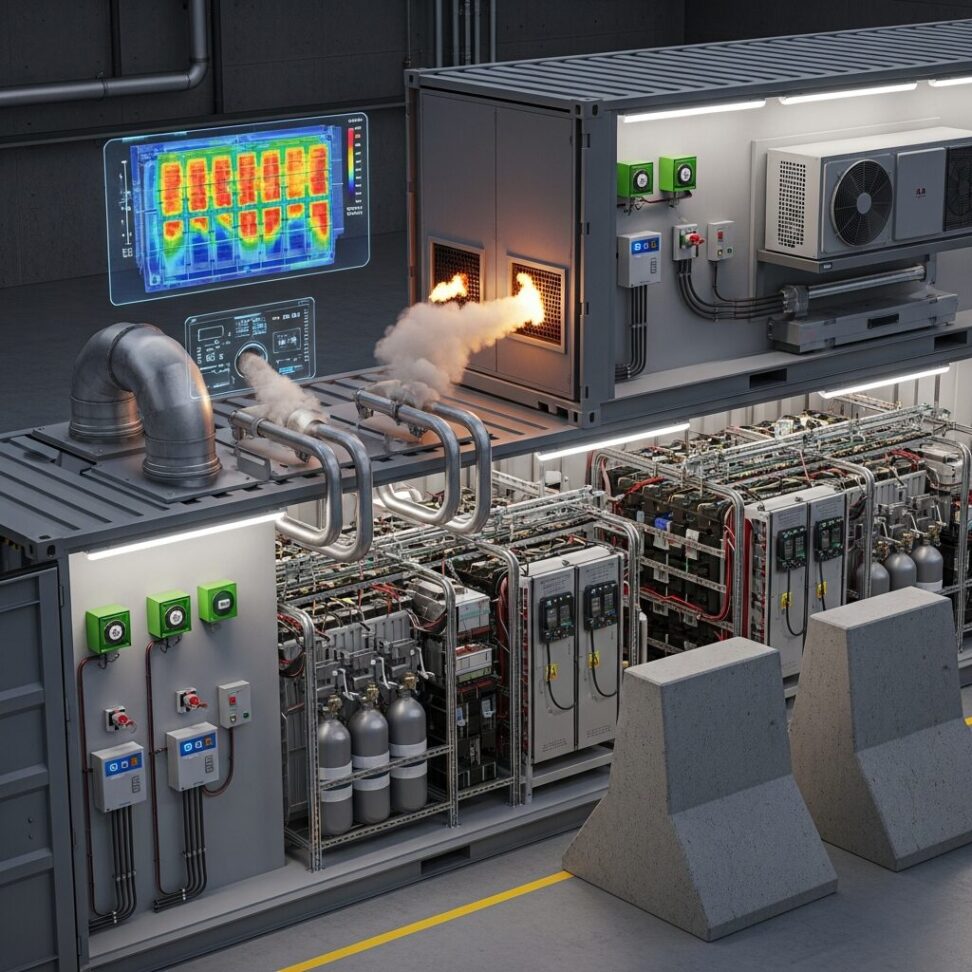
Containerised Battery Energy Storage Safety and Explosion Protection
As renewable energy adoption accelerates worldwide, containerised battery energy storage systems (BESS) have become a cornerstone of grid stability and energy resilience. These self-contained units, typically housing lithium-ion battery arrays, offer scalable storage solutions for utilities, industrial facilities, and renewable energy developers. However, their growing deployment brings pressing safety challenges, particularly around fire and explosion risks that demand rigorous engineering strategies.
Understanding the Risks of Lithium-Ion Battery Storage
Lithium-ion batteries, while efficient and energy-dense, are susceptible to thermal runaway, a chain reaction triggered by overheating, mechanical damage, overcharging, or internal short circuits. When thermal runaway occurs, batteries release flammable and toxic gases, including hydrogen, carbon monoxide, and hydrocarbons. Within the confined environment of a shipping container, these gases can quickly accumulate to explosive concentrations.
The consequences of ignored gas buildup have been documented in several high-profile BESS incidents globally, where explosions have caused significant property damage, injuries, and lengthy operational downtime. As storage capacities scale into the hundreds of megawatt-hours, the potential impact of such incidents grows proportionally.
Layered Explosion Protection Strategies
Effective safety design for containerised BESS relies on a multi-layered approach that combines prevention, detection, and mitigation. Rather than depending on a single safeguard, engineers integrate several complementary systems.
- Early gas detection: Sensors capable of identifying off-gassing before thermal runaway becomes catastrophic provide critical warning time. Detecting hydrogen and other volatile compounds at low parts-per-million levels allows automated systems to respond before ignition conditions develop.
- Deflagration venting: Engineered vent panels release pressure safely if an explosion occurs, directing energy away from personnel and adjacent equipment. Proper vent sizing is calculated using standards such as NFPA 68.
- Explosion prevention systems: Active systems including forced ventilation and inert gas suppression can maintain gas concentrations below the lower explosive limit (LEL), removing the possibility of ignition.
- Thermal management: Robust cooling systems and battery management software help keep cells within safe operating temperatures, addressing the root cause of many failures.
The Role of Standards and Compliance
Industry standards play a central role in guiding safe BESS design. NFPA 855, the Standard for the Installation of Stationary Energy Storage Systems, and UL 9540A, which addresses test methods for evaluating thermal runaway fire propagation, are widely referenced. Compliance with these standards is increasingly required by insurers, authorities having jurisdiction (AHJs), and project financiers.
In Europe, the ATEX Directive governs equipment intended for use in potentially explosive atmospheres, while IECEx provides a global certification framework. Containerised BESS installations must often meet requirements from multiple overlapping standards, particularly when deployed across jurisdictions.