
GridSmart Battery Program: PSE&G Launches Residential Energy Storage Pilot
Public Service Enterprise Group (PSE&G), one of the largest utility holding companies in New Jersey serving millions of electric and gas customers, has introduced a new initiative aimed at bringing residential battery storage into the mainstream. Called the GridSmart Battery Program, the pilot represents a step toward integrating home energy storage systems directly into the utility’s grid management strategy.
What the GridSmart Battery Program Offers
The program is designed to encourage homeowners to install battery storage systems paired with their existing or new solar arrays. Rather than simply supporting private energy independence, the initiative ties customer-owned batteries into PSE&G’s broader grid operations, allowing the utility to draw on stored energy during periods of high demand.
Participants who enroll in the pilot can receive financial incentives for installing qualifying battery systems. In exchange, PSE&G gains the ability to tap into a portion of that stored energy when the grid needs additional support, particularly during peak demand events in the summer months when air conditioning use strains the system.
Why Utilities Are Turning to Distributed Storage
Programs like GridSmart reflect a shift happening across the utility sector. Instead of relying solely on large, centralized power plants or single grid-scale battery installations, utilities are increasingly looking at the potential of thousands of small, distributed batteries sitting in customers’ garages and basements.
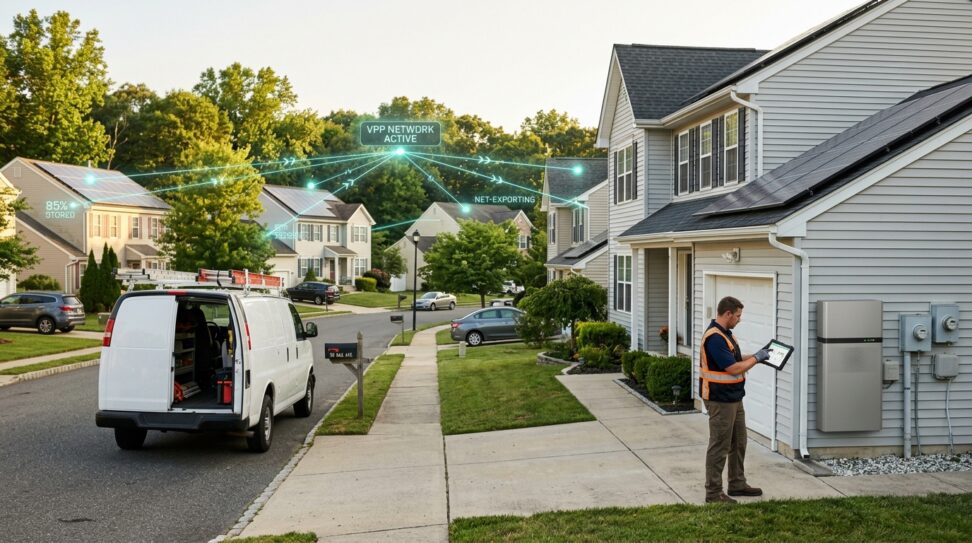
This approach, often referred to as a virtual power plant, allows a utility to aggregate the collective capacity of many small systems and dispatch that stored energy much like a traditional power plant would. Benefits attributed to this model include:
- Reduced strain on the grid during peak demand periods
- Lower need for costly infrastructure upgrades
- Increased resilience for individual households during outages
- Better utilization of solar energy generated but not immediately consumed
For PSE&G, the GridSmart pilot offers a way to test how effectively distributed batteries can be coordinated at scale, while gathering data on customer participation, technical performance, and grid impact.
How the Pilot Program Works
Eligible customers who join the program agree to allow PSE&G limited access to their battery systems during specified events. In return, participants receive compensation, which can come in the form of upfront incentives, ongoing bill credits, or a combination of both, depending on the structure of the pilot.
The batteries remain under the homeowner’s control for daily use, powering the household and storing solar energy as usual. It is only during defined grid events, typically during periods of peak electricity demand, that PSE&G can draw down a portion of the stored energy to help balance supply and demand across its service territory in New Jersey.
Addressing Grid Reliability in New Jersey
New Jersey, like many states in the Northeast and Mid-Atlantic, has faced growing pressure on its electric grid due to rising demand, extreme weather events, and the increasing electrification of transportation and heating. Summer heat waves in particular can push electricity consumption to levels that challenge existing infrastructure.
By tapping into residential batteries, PSE&G aims to create an additional buffer of capacity that can be called upon without needing to build new peaker plants or expand transmission infrastructure as quickly. This aligns with broader state goals around clean energy adoption and grid modernization, as New Jersey continues to push forward with policies supporting solar installation and energy storage deployment.
What This Means for Homeowners
For homeowners considering solar and storage, the GridSmart program adds a new financial incentive to the equation. Battery systems, while valuable for backup power and maximizing solar self-consumption, often carry a significant upfront cost. Programs that offer compensation for grid participation can help offset that investment and shorten the payback period.
Homeowners interested in the program should consider several factors before enrolling:
- Battery system compatibility with the utility’s program requirements
- The frequency and duration of expected grid events
- Compensation structure and how it compares to standalone battery ownership
- Impact on backup power availability during outages
As with any pilot program, terms and eligibility criteria may evolve as PSE&G gathers data and refines the initiative based on real-world participation.
Looking Ahead
The GridSmart Battery Program places PSE&G among a growing list of utilities across the country experimenting with residential storage aggregation. As battery costs continue to decline and adoption grows, programs like this could become an increasingly common tool for utilities managing the dual challenge of rising demand and the transition toward cleaner energy sources.
The success of this pilot in New Jersey may help shape how PSE&G and other utilities in the region approach distributed energy resources going forward, potentially paving the way for expanded programs that further integrate customer-owned batteries into everyday grid operations.
Analyzed and outlined by Claude Sonnet 5, images by Gemini 3.1 Flash.
**Source** https://www.latitudemedia.com/industry-news/pseg-introduces-gridsmart-battery-program-a-new-residential-battery-storage-pilot/