
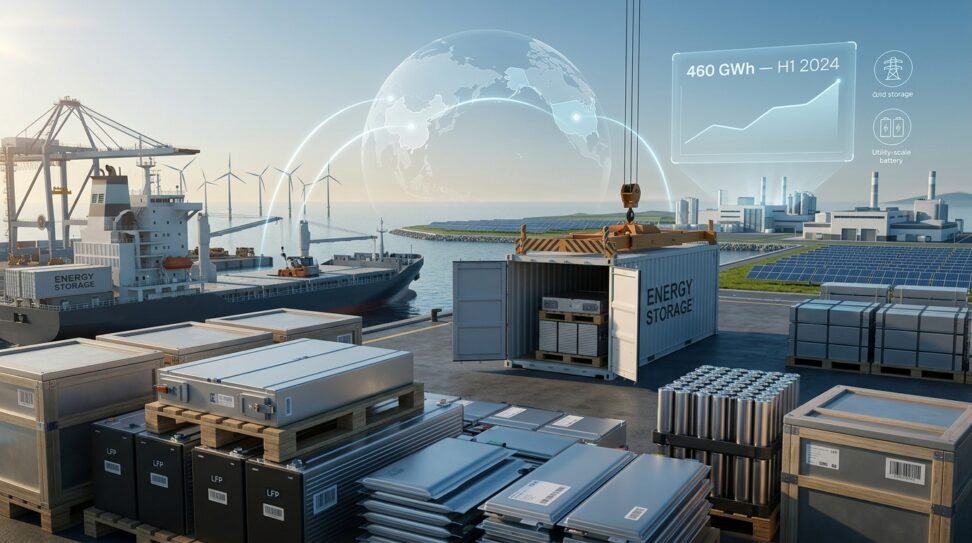
Global Energy Storage Cell Shipments Surge Past 460 GWh Midyear
The energy storage sector has hit a significant milestone in 2024, with global shipments of energy storage cells surpassing 460 GWh in the first half of the year alone. This figure signals a continued acceleration in demand for battery storage technology, driven largely by utility-scale projects, grid stabilization needs, and the ongoing expansion of renewable energy infrastructure worldwide.
Industry data indicates that this surge reflects both stronger-than-expected demand and aggressive capacity expansion by leading battery manufacturers, most of whom are based in China. The growth trajectory suggests that full-year 2024 shipment figures could set new records, building on the momentum established in previous years.
What’s Driving the Growth
Several factors are converging to push energy storage cell shipments to new heights:
- Utility-scale storage deployment continues to expand as grid operators seek to balance intermittent renewable generation from solar and wind sources
- Falling lithium carbonate prices have made battery cells more cost-competitive, encouraging wider adoption across residential, commercial, and industrial applications
- Government incentives and renewable energy mandates in key markets, including the United States, China, and the European Union, are accelerating storage project pipelines
- Manufacturers are ramping up production capacity to meet anticipated demand growth through the remainder of the decade
Leading Manufacturers Shaping the Market
The energy storage cell market remains concentrated among a handful of dominant players, most notably Chinese battery manufacturers who continue to hold the largest share of global shipments.
CATL (Contemporary Amperex Technology Co. Limited) remains the world’s largest battery manufacturer, supplying cells for both electric vehicles and stationary storage applications. The company has continued to invest heavily in expanding its storage-specific product lines, including its EnerOne and other utility-scale battery systems.
BYD, another major Chinese manufacturer known for its vertically integrated approach spanning batteries, electric vehicles, and renewable energy systems, has also been a significant contributor to global storage cell shipments. The company’s Blade Battery technology has found applications in both automotive and stationary storage markets.
EVE Energy, a growing force in the battery manufacturing space, has been expanding its footprint in the energy storage segment, supplying cells to various system integrators worldwide.
REPT BATTERO and other emerging manufacturers have also gained traction, reflecting a broadening competitive landscape as more companies invest in production capacity to capture rising demand.
Regional Demand Patterns
China continues to represent the largest market for both production and consumption of energy storage cells, driven by aggressive renewable energy targets and grid modernization efforts. However, demand from North America and Europe has been steadily increasing as these regions push forward with their own decarbonization goals and renewable energy integration plans.
The United States, in particular, has seen growing utility-scale storage deployment as part of broader efforts to stabilize grids increasingly reliant on solar and wind power. Policy support, including incentives tied to domestic manufacturing and clean energy adoption, has further bolstered demand in the region.
Market Outlook for the Remainder of 2024
Analysts tracking the sector suggest that the pace of growth witnessed in the first half of 2024 is likely to continue, barring any significant supply chain disruptions or unexpected shifts in raw material pricing. Lithium iron phosphate (LFP) chemistry continues to dominate the storage cell market due to its cost advantages, safety profile, and longer cycle life compared to alternative chemistries.
The continued decline in raw material costs, particularly lithium, has played a substantial role in making storage projects more economically viable, further supporting the sector’s expansion. This cost reduction trend, combined with technological improvements in energy density and cycle life, positions the energy storage industry for sustained growth through the latter half of 2024 and into 2025.
Implications for the Renewable Energy Transition
The surge in energy storage cell shipments carries significant implications for the broader energy transition. As more storage capacity comes online, grid operators gain greater flexibility to manage variable renewable energy sources, reducing curtailment and improving overall system reliability.
This growth also signals increasing investor and manufacturer confidence in the long-term viability of the energy storage market, as capacity expansions typically reflect expectations of sustained demand growth. For renewable energy developers, the availability of more affordable and higher-performing storage cells translates into more viable project economics, potentially accelerating the pace of new solar and wind installations paired with battery storage.
As the industry moves into the second half of 2024, market watchers will be closely monitoring whether this growth trajectory holds steady, particularly as new manufacturing capacity comes online and competition among battery makers intensifies.
Analyzed and outlined by Claude Sonnet 5, images by Gemini 3.1 Flash.
**Source** https://www.moomoo.com/news/post/75271821/trendforce-global-energy-storage-cell-shipments-exceeded-460-gwh-in