
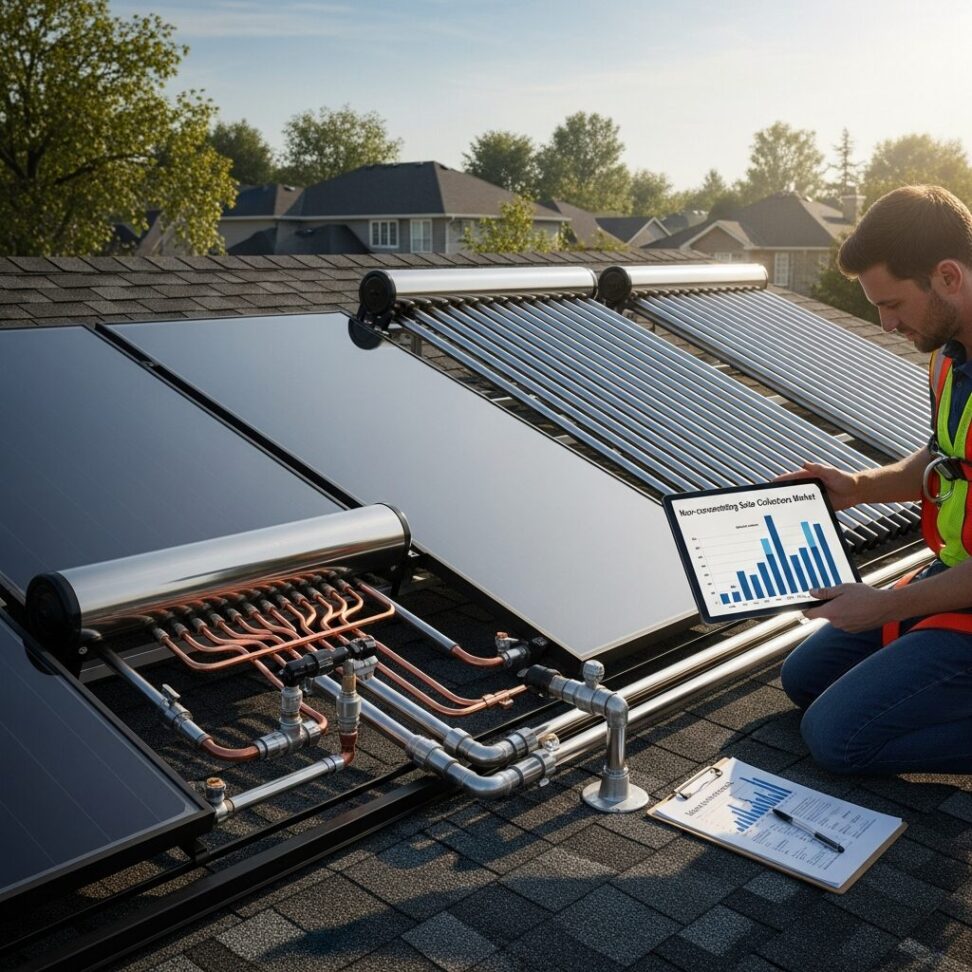
Non-Concentrating Solar Collectors Market Growth in Northern America
The renewable energy sector continues to expand across Northern America, with non-concentrating solar collectors representing a significant segment of this growth. These systems, which capture solar radiation without the need for focusing mechanisms, are becoming increasingly prevalent in residential, commercial, and industrial applications throughout the region.
Understanding Non-Concentrating Solar Technology
Non-concentrating solar collectors operate by absorbing sunlight directly through flat-plate or evacuated tube designs. Unlike their concentrating counterparts that use mirrors or lenses to focus sunlight, these systems collect solar energy across their entire surface area. This simpler design makes them particularly suitable for applications requiring lower to medium temperature ranges, such as domestic water heating, space heating, and pool heating.
The technology has gained traction due to its reliability, lower maintenance requirements, and cost-effectiveness compared to more complex solar systems. These collectors can operate efficiently even under diffuse light conditions, making them practical for regions with varying weather patterns.
Market Dynamics in Northern America
The Northern American market for non-concentrating solar collectors has shown steady development driven by several factors. Government incentives and tax credits continue to encourage both residential and commercial adoption of solar heating technologies. Additionally, rising energy costs and growing environmental awareness have prompted property owners to seek alternative heating solutions.
The residential sector remains the largest consumer of non-concentrating solar collectors, with homeowners installing these systems primarily for water heating purposes. Commercial buildings, including hotels, hospitals, and educational facilities, have also increased their deployment of these technologies to reduce operational costs and meet sustainability targets.
Regional Installation Patterns
Installation rates vary across Northern America based on climate conditions, energy prices, and local policy frameworks. Areas with high solar irradiance naturally see greater adoption, though technological improvements have made these systems viable even in regions with less consistent sunshine.
The United States leads the market in terms of installed capacity, with particular strength in states that have implemented supportive renewable energy policies. Canada has also witnessed growing interest, especially in provinces where heating costs remain high during extended winter months. Mexico’s market continues to develop, supported by increasing industrial applications and government renewable energy initiatives.
Economic Considerations
The economic appeal of non-concentrating solar collectors stems from their ability to provide relatively quick payback periods. Installation costs have declined over recent years due to improved manufacturing processes and increased market competition. This cost reduction has made the technology accessible to a broader range of consumers.
Energy savings generated by these systems can be substantial, particularly in applications with high hot water demands. Many installations achieve payback periods of five to ten years, depending on local energy rates and system size. The longevity of these systems, often lasting twenty to thirty years with proper maintenance, provides long-term value to investors.
Future Market Outlook
The trajectory for non-concentrating solar collectors in Northern America appears positive. Continued policy support for renewable energy, combined with advancing technology and decreasing costs, should sustain market growth. Building codes in various jurisdictions are increasingly incorporating solar-ready provisions, potentially accelerating adoption rates.
Innovation in materials and design continues to improve collector efficiency and durability. Integration with smart home systems and thermal storage solutions is expanding the functionality and appeal of these installations. Industrial applications are also expected to grow as businesses seek to decarbonize their operations.
Challenges and Opportunities
Despite positive trends, the market faces certain challenges. Competition from other renewable technologies, particularly photovoltaic solar panels, requires clear communication about the specific benefits of thermal collectors. Installation quality remains critical for system performance, necessitating adequate training for contractors and installers.
The growing emphasis on net-zero buildings presents significant opportunities for non-concentrating solar collectors. These systems can play an essential role in reducing building energy consumption when integrated into comprehensive energy strategies. Retrofit applications in existing buildings also represent an untapped market segment with considerable potential.
Market participants who can demonstrate reliability, provide quality installation services, and educate consumers about long-term benefits will be well-positioned to capitalize on the expanding Northern American market for non-concentrating solar collectors.
Analyzed and outlined by Claude Sonnet 4.5, images by Imagen 4.0 Ultra.
**Source**
https://www.indexbox.io/store/northern-america-non-concentrating-solar-collectors-market-analysis-forecast-size-trends-and-insights/