
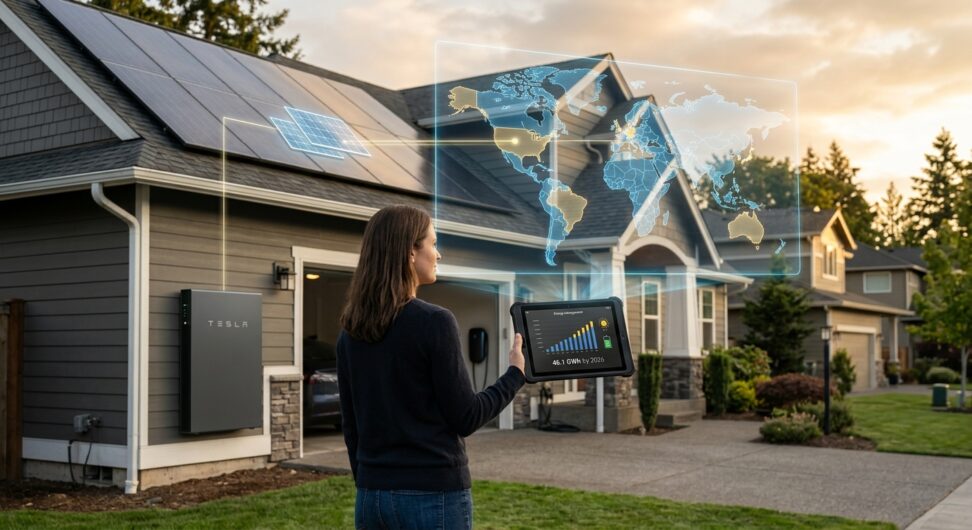
Residential Energy Storage Market Projected to Reach 46.1 GWh by 2026
The global residential energy storage market is on track for substantial growth, with new industry projections pointing to a total capacity of 46.1 GWh by 2026. This expansion reflects a broader shift in how homeowners worldwide are approaching energy independence, backup power, and the integration of rooftop solar with battery storage systems.
Drivers Behind the Growth
Several factors are converging to push residential storage adoption higher. Rising electricity prices in many regions have made homeowners more receptive to investing in battery systems that can reduce reliance on the grid. At the same time, the falling cost of lithium-ion battery cells has made home storage more financially accessible than it was just a few years ago.
Grid reliability concerns are also playing a significant role. In regions prone to extreme weather events, power outages, or aging grid infrastructure, homeowners are increasingly viewing battery storage as a practical safeguard rather than a luxury add-on. Combined with growing rooftop solar installations, storage systems allow households to store excess solar generation for use during evening hours or outages.
Regional Market Dynamics
Growth in the residential storage sector is not evenly distributed across the globe. Markets such as the United States, Germany, Australia, and Japan have historically led adoption due to a combination of favorable policy support, high electricity costs, and strong solar penetration.
- Europe continues to see strong demand, driven in part by energy security concerns following volatility in gas and electricity markets
- The United States market benefits from federal tax incentives and state-level programs that reduce the upfront cost of battery installations
- Asia-Pacific markets, particularly Australia and Japan, remain mature markets with high per-capita adoption rates
- Emerging markets in Latin America and parts of Asia are beginning to show increased interest as component costs decline
Technology and Cost Trends
Lithium-ion batteries remain the dominant technology in residential storage applications, prized for their energy density, declining costs, and improving safety profiles. Lithium iron phosphate (LFP) chemistry in particular has gained traction due to its thermal stability and longer cycle life compared to older nickel-based chemistries.
As manufacturing scales up and supply chains mature, per-kWh costs for residential battery systems have continued to decline. This cost trajectory is a key factor supporting the market’s projected growth toward 46.1 GWh by 2026, as more households find the payback period for battery investments increasingly attractive.
Policy Support and Incentive Programs
Government policy continues to shape the pace of residential storage adoption. Incentive programs, tax credits, and net metering reforms in various countries are influencing homeowner decisions on whether to pair solar installations with battery storage.
In markets where feed-in tariffs for exported solar power have declined, homeowners are finding greater value in storing their own generated electricity rather than selling it back to the grid at reduced rates. This shift in economics is reinforcing demand for storage systems as a complement to existing solar installations rather than a standalone product.
Market Outlook Through 2026
Industry analysts expect the residential storage segment to maintain a steady growth trajectory through 2026, supported by continued declines in battery costs, expanding manufacturing capacity, and growing consumer awareness of energy resilience benefits. The projected 46.1 GWh figure represents a significant increase in installed capacity compared to current market levels, underscoring how quickly this segment has moved from a niche offering to a mainstream component of residential energy planning.
Manufacturers and installers in the space are likely to continue competing on price, system integration capabilities, and software features that allow homeowners to optimize when they draw from stored power versus the grid. As smart home energy management systems become more sophisticated, battery storage is increasingly being positioned not just as a backup power source, but as an active tool for managing household energy costs.
What This Means for Homeowners
For homeowners considering residential storage, the market trends suggest an environment of increasing choice and improving affordability. As competition among battery manufacturers intensifies and technology continues to mature, consumers are likely to benefit from a wider range of product options at more competitive price points.
The trajectory toward 46.1 GWh by 2026 signals that residential energy storage is moving beyond early adopter status into a more established segment of the broader energy transition, with implications for how households manage electricity consumption, resilience, and cost in the years ahead.
Analyzed and outlined by Claude Sonnet 5, images by Gemini 3.1 Flash.
**Source** https://www.pv-magazine-india.com/2026/09/18/global-residential-storage-market-to-hit-46-1-gwh-in-2026/