
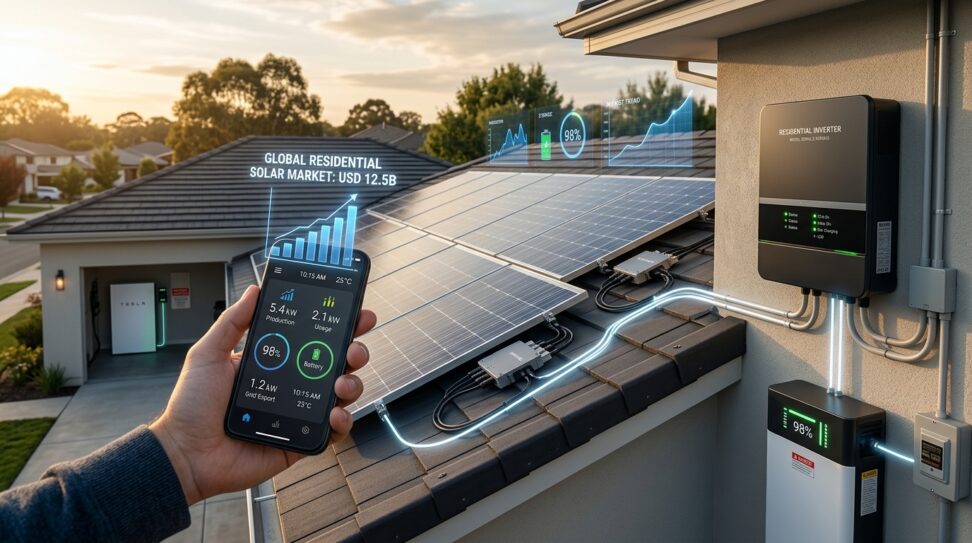
Residential Solar Power Inverters Market Growth to USD 12.5 Billion
The global residential solar power inverter market is on track for substantial expansion, with projections indicating growth to USD 12.5 billion in the coming years. This upward trajectory reflects the accelerating shift toward rooftop solar installations among homeowners worldwide, driven by falling equipment costs, supportive government policies, and rising electricity prices that make self-generated power increasingly attractive.
Market Overview and Growth Drivers
Solar power inverters are a critical component of any residential photovoltaic system, converting the direct current (DC) electricity generated by solar panels into alternating current (AC) electricity usable by household appliances. As more homeowners install solar panel systems to reduce dependence on traditional utility grids and lower energy bills, demand for reliable and efficient inverters has climbed correspondingly.
Several factors are fueling this market expansion:
- Declining costs of solar panel installation and associated hardware
- Government incentives, tax credits, and net metering policies in multiple countries
- Growing consumer awareness of climate change and desire for sustainable energy sources
- Advancements in inverter technology, including smart and hybrid inverters
- Increasing adoption of battery storage systems paired with solar installations
Types of Residential Solar Inverters
The residential solar inverter market encompasses several distinct technologies, each suited to different household needs and system configurations:
- String inverters: The most common and cost-effective option, connecting multiple solar panels in a series
- Microinverters: Installed on each individual panel, offering improved efficiency and monitoring capabilities
- Hybrid inverters: Designed to work with battery storage systems, allowing homeowners to store excess energy
- Power optimizers: Used alongside string inverters to maximize energy harvest from each panel
Microinverters and hybrid inverters are experiencing particularly strong demand growth, as homeowners increasingly seek systems that offer greater flexibility, better performance monitoring, and the ability to store energy for use during power outages or peak pricing periods.
Regional Market Dynamics
North America, Europe, and Asia-Pacific represent the largest markets for residential solar inverters, each shaped by distinct regulatory and economic conditions. The United States continues to see strong residential solar adoption, supported by federal tax credits and state-level incentive programs. European countries, particularly Germany, the Netherlands, and Italy, have long been leaders in residential solar due to high electricity costs and strong environmental policy frameworks.
Meanwhile, the Asia-Pacific region, led by countries such as China, India, Japan, and Australia, is emerging as a significant growth region. Rising urbanization, expanding middle-class populations, and government-backed rural electrification programs are contributing to increased residential solar installations across the region.
Competitive Landscape
The residential solar inverter market includes a mix of established electronics manufacturers and specialized solar technology companies. Key players in this space include:
- SMA Solar Technology AG, a German company recognized as one of the pioneers in solar inverter manufacturing, offering a wide range of string and hybrid inverters for residential and commercial applications
- Enphase Energy, a US-based company known for its microinverter technology and integrated solar-plus-storage solutions
- SolarEdge Technologies, an Israeli company specializing in power optimizers and inverter systems designed to maximize energy production
- Huawei Technologies, a Chinese multinational that has expanded into the solar inverter segment as part of its broader digital energy portfolio
- Sungrow Power Supply, a Chinese manufacturer producing a broad range of inverters for both residential and utility-scale solar projects
- Fronius International, an Austrian company offering solar inverter solutions alongside its core welding and battery charging businesses
These companies continue to invest in research and development to improve inverter efficiency, reduce costs, and integrate smart features such as remote monitoring, automatic fault detection, and compatibility with home energy management systems.
Technology Trends Shaping the Future
Smart inverter technology is becoming a defining feature of the residential market. These devices allow homeowners to monitor energy production and consumption in real time through mobile applications, while also enabling grid operators to manage distributed energy resources more effectively. Integration with home battery systems is another notable trend, as consumers seek greater energy independence and resilience against grid outages.
Additionally, the push toward more compact, lightweight, and durable inverter designs is helping manufacturers meet the aesthetic and installation preferences of residential customers. Improved thermal management and extended warranty periods are also becoming standard offerings as competition intensifies among manufacturers.
Challenges Facing the Market
Despite positive growth projections, the residential solar inverter market faces certain challenges. Supply chain disruptions affecting semiconductor components have periodically impacted production timelines. Additionally, varying regulatory standards across different countries and regions can complicate product certification and market entry for manufacturers. Price competition, particularly from manufacturers based in China, has also placed pressure on profit margins throughout the industry.
Outlook for the Coming Years
As the residential solar power inverter market approaches its projected valuation of USD 12.5 billion, indust