
LFP Battery Powder Market Growth Accelerates Through 2035 Surge
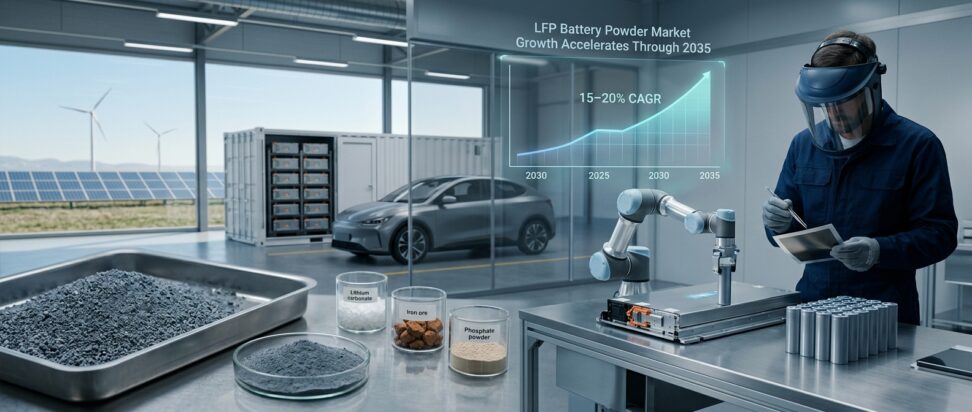
The global lithium iron phosphate (LFP) powder market is entering a sustained growth phase, with industry forecasts pointing to a compound annual growth rate (CAGR) of 15-20% through 2035. This trajectory is being driven primarily by the expanding electric vehicle (EV) sector and the increasing adoption of energy storage systems worldwide, positioning LFP powder as one of the more important materials in the battery supply chain over the next decade.
What Is Driving the LFP Powder Boom
Lithium iron phosphate powder serves as the cathode material in LFP batteries, an alternative to nickel- and cobalt-based chemistries such as NMC (nickel manganese cobalt). LFP batteries have gained favor across multiple industries due to their lower production costs, longer cycle life, and improved thermal stability compared to other lithium-ion battery types.
These characteristics have made LFP chemistry particularly attractive for two major applications:
- Electric vehicles, where automakers are increasingly turning to LFP batteries for standard-range models to reduce costs while maintaining acceptable performance
- Grid-scale and residential energy storage systems, where safety and longevity outweigh the need for maximum energy density
As renewable energy installations continue to expand globally, the need for reliable storage solutions has grown in parallel, further reinforcing demand for LFP-based systems.
Regional Market Dynamics
China continues to dominate LFP powder production and consumption, benefiting from an established supply chain that includes raw material processing, cathode manufacturing, and battery assembly. Chinese battery makers have been central to popularizing LFP chemistry, particularly after companies like BYD and CATL scaled up LFP-based battery production for both domestic and export markets.
Beyond China, other regions are working to build out their own LFP supply chains. North America and Europe have both seen increased investment in battery material production facilities, partly driven by policy incentives aimed at reducing reliance on imported battery components and securing domestic supply chains for critical minerals and materials.
Cost Advantages Fueling Adoption
One of the central reasons LFP powder demand continues to climb is cost. Unlike NMC batteries, LFP chemistry does not require cobalt or nickel, two materials that have historically been subject to price volatility and supply chain concerns tied to geopolitical and ethical sourcing issues. This cost stability has made LFP an appealing option for manufacturers looking to produce more affordable EVs and storage systems without sacrificing safety.
Additionally, LFP batteries typically offer a longer operational lifespan, often exceeding 3,000 to 6,000 charge cycles depending on application and design. This durability translates into a lower total cost of ownership over time, an important consideration for both EV manufacturers and utility-scale storage operators.
Technology Improvements Expanding Use Cases
While LFP batteries have traditionally lagged behind NMC chemistries in energy density, ongoing advances in cell design and pack engineering have narrowed this gap. Techniques such as cell-to-pack integration, where individual cells are packed more efficiently without traditional module housings, have allowed manufacturers to improve the effective energy density of LFP-based battery packs.
These engineering improvements have expanded the range of applications suitable for LFP technology, moving it beyond entry-level EVs into a broader array of vehicle segments and storage applications that previously required higher energy density chemistries.
Supply Chain Considerations
As demand for LFP powder grows, attention has turned to the availability and processing of raw materials, including lithium, iron, and phosphate sources. While iron and phosphate are more widely available and less geographically concentrated than cobalt or nickel, scaling up production capacity to meet the projected 15-20% CAGR will require continued investment in mining, refining, and cathode material manufacturing infrastructure.
Market analysts tracking the sector have noted that companies positioned across multiple stages of the LFP supply chain, from raw material sourcing to cathode powder production, are likely to benefit most from the sustained growth period extending through 2035.
Looking Ahead
The forecast period through 2035 suggests LFP powder will remain a central component of the global battery materials landscape. With electric vehicle adoption continuing to rise and energy storage deployment accelerating alongside renewable energy expansion, the underlying demand drivers for LFP chemistry appear structurally supported rather than temporary.
Manufacturers, material suppliers, and policymakers will likely continue monitoring this market closely, as shifts in battery chemistry preferences can have significant implications for mineral demand, manufacturing investment, and the broader trajectory of the clean energy transition.
Analyzed and outlined by Claude Sonnet 5, images by Gemini 3.1 Flash.
**Source** https://www.indexbox.io/blog/lithium-iron-phosphate-powder-market-forecast-to-2035-lfp-battery-demand-drives-15-20-cagr/