
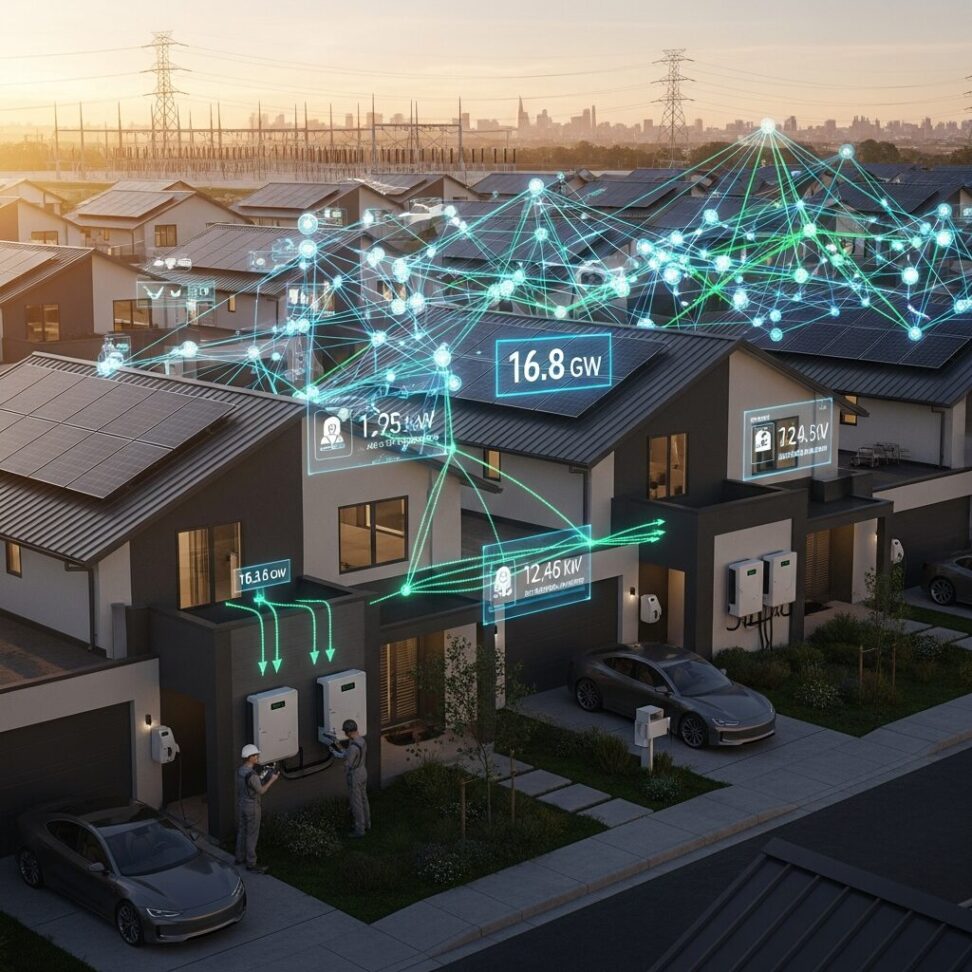
Sunrun, Tesla, and Renew Home Launch 16.8 GW Virtual Power Plant
Three major players in the residential solar and energy storage industry have joined forces to create one of the largest virtual power plant (VPP) programs ever announced in the United States. Sunrun, Tesla, and Renew Home unveiled plans on June 25, 2026, for a 16.8 GW virtual power plant program designed to support grid reliability while delivering value to homeowners with solar-plus-storage systems.
What the Partnership Entails
The collaboration brings together three companies with complementary strengths in distributed energy resources. The program will aggregate residential solar panels, home battery systems, and smart thermostats across participating households to function as a single, dispatchable power resource. When grid operators face peak demand or supply constraints, the network can discharge stored energy or reduce consumption to balance the system.
At 16.8 GW of combined capacity, the program rivals the output of multiple large-scale conventional power plants. The initiative is positioned as a way to address growing electricity demand driven by data centers, electrification, and extreme weather events, all without building new fossil fuel generation.
About the Companies Involved
Sunrun is the largest residential solar installer in the United States, headquartered in San Francisco, California. The company offers solar panel installation, battery storage, and energy services to homeowners across the country and has been a leading developer of virtual power plant programs through utility partnerships.
Tesla, based in Austin, Texas, is widely known for its electric vehicles but also produces the Powerwall home battery system, which has become one of the most widely adopted residential energy storage products globally. Tesla’s energy division has expanded significantly in recent years, with its Powerwall fleet already participating in VPP programs in several states.
Renew Home was formed in 2024 through the merger of Google Nest Renew and OhmConnect. The company manages one of the largest residential demand response networks in North America, using smart devices and behavioral programs to shift household electricity use during periods of grid stress.
How Virtual Power Plants Work
Virtual power plants connect thousands of distributed energy resources, such as rooftop solar systems, batteries, smart thermostats, and electric vehicle chargers, into a coordinated network. Software platforms control when these devices charge, discharge, or reduce consumption based on grid conditions and market signals.
For homeowners, participation typically means:
- Earning incentive payments for allowing limited use of their stored energy
- Reduced electricity bills through optimized energy management
- Continued backup power during outages
- Contributing to cleaner grid operations
Why This Matters for the Grid
The United States grid is facing mounting pressure from rising electricity demand. Forecasts show load growth accelerating after nearly two decades of flat demand, driven primarily by data center expansion, manufacturing reshoring, and electrification of transportation and heating. At the same time, aging infrastructure and increasing weather-related events have strained reliability.
Virtual power plants offer a fast-to-deploy solution. Unlike traditional power plants, which can take years to permit and build, VPPs leverage existing residential equipment that is already installed or being installed every day. The U.S. Department of Energy has identified VPPs as