
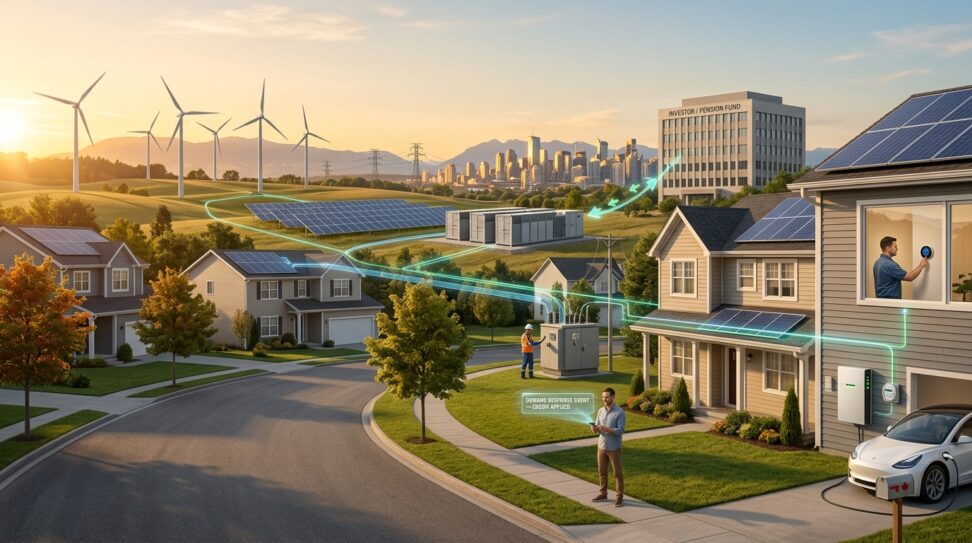
Canada’s Record Clean Energy Investment and Household Demand Response Revolution
Canada is experiencing a notable shift in how energy is financed, generated, and consumed. Clean energy investment across the country has reached record levels, while a growing number of households are becoming active participants in grid management through demand response programs. Together, these trends point toward a more distributed, flexible, and resilient energy system taking shape across Canadian provinces.
Record-Breaking Clean Energy Capital Flows
Investment in Canadian clean energy projects has climbed to unprecedented levels, driven by a combination of federal incentives, provincial procurement programs, and private sector confidence in the long-term economics of renewables. Wind, solar, battery storage, and grid modernization projects are attracting capital from both domestic pension funds and international investors looking for stable, long-duration returns.
This surge in funding reflects a broader trend seen globally, where energy security concerns and decarbonization commitments are pushing capital toward diversified energy portfolios. In Canada specifically, provinces such as Alberta, Ontario, and Quebec have each taken distinct approaches to attracting this investment, ranging from competitive auctions to tax credit structures aimed at accelerating project timelines.
The Rise of Household Demand Response
Alongside large-scale investment, a quieter but equally significant transformation is occurring inside Canadian homes. Demand response programs, which incentivize households to shift or reduce electricity usage during peak demand periods, are seeing rapid adoption. Utilities are increasingly turning to residential customers as a flexible resource to help balance grid load without building additional peaking capacity.
These programs typically work by offering bill credits or direct payments to households that agree to reduce consumption during specific hours, often through smart thermostats, connected water heaters, or electric vehicle charging schedules. The technology enabling this shift has matured considerably, making it easier for utilities to coordinate thousands of individual homes as a collective grid resource.
- Smart thermostats that automatically adjust during peak events
- Managed EV charging that shifts to off-peak hours
- Battery storage systems that discharge stored solar power during high-demand periods
- Direct load control programs for water heaters and air conditioners
Why This Matters for Grid Stability
Canada’s electricity demand is expected to grow substantially in the coming years, driven by electrification of transportation, heating, and industrial processes. Rather than relying solely on new generation capacity to meet this demand, grid operators are recognizing that flexible household consumption can defer or reduce the need for expensive infrastructure upgrades.
This approach mirrors strategies already deployed in parts of the United States and Europe, where aggregated residential demand response has proven capable of shaving meaningful load off peak periods. For Canadian utilities facing cold winters and hot summers with sharp demand spikes, this flexibility offers a practical tool for managing reliability at lower cost than traditional peaker plants.
Provincial Approaches Vary
Ontario’s Independent Electricity System Operator has expanded its demand response auction programs, allowing aggregators to bid pools of residential and commercial flexibility into the wholesale market. Quebec’s Hydro-Québec, a provincially owned utility serving millions of customers, has similarly rolled out winter credit programs that reward customers for reducing consumption during cold snaps when demand strains the grid.
In Alberta, where the electricity market operates under a more deregulated structure, private retailers and technology companies are competing to offer demand response products directly to consumers, often bundling them with home energy management platforms.
Investment and Consumer Behavior Converge
What makes this moment distinct is how capital investment and consumer behavior are reinforcing one another. As more renewable capacity comes online, the variability of wind and solar generation creates a greater need for flexible demand that can respond to real-time grid conditions. Household demand response fills that gap, making the broader clean energy transition more workable from an operational standpoint.
At the same time, the financial returns available to demand response participants are attracting attention from consumers who might otherwise be indifferent to grid dynamics. Modest bill savings, combined with the convenience of automated smart home systems, are lowering the barrier to participation.
Looking Ahead
Industry observers expect both trends to continue through the remainder of the decade. Continued federal support through tax credits and provincial procurement targets should sustain investment momentum, while falling costs for smart home hardware will likely expand demand response enrollment beyond early adopters into mainstream households.
The combination of record capital deployment and growing household participation suggests Canada’s energy system is moving toward a model where flexibility, not just generation capacity, becomes a central pillar of grid reliability. This shift carries implications not only for utilities and investors but for everyday Canadians who may increasingly find themselves as active participants in a smarter, more responsive electricity grid.
Analyzed and outlined by Claude Sonnet 5, images by Gemini 3.1 Flash.
**Source** https://www.renewableenergyworld.com/energy-business/the-price-of-all-of-the-above-factor-this-brief/