
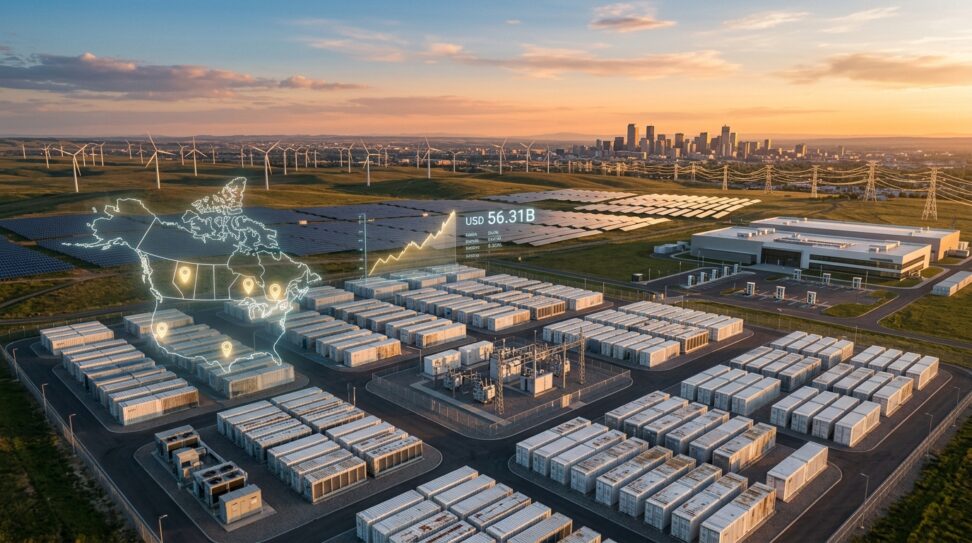
North America Battery Energy Storage Market Grows to $56.31 Billion
The battery energy storage market across North America is on track for substantial expansion, with projections indicating growth to USD 56.31 billion. This surge reflects the region’s accelerating shift toward renewable energy integration, grid modernization, and the growing need for reliable power backup solutions amid increasing climate volatility and energy demand.
Market Drivers Fueling Growth
Several factors are converging to push this market forward. The rapid adoption of solar and wind energy across the United States and Canada has created a pressing need for storage solutions that can manage intermittent power generation. Battery energy storage systems (BESS) allow utilities and businesses to store excess energy during peak production periods and release it when demand rises or generation dips.
Government incentives and policy support have also played a significant role. Tax credits, grants, and regulatory frameworks designed to encourage clean energy adoption have made battery storage projects more financially viable for utilities, commercial enterprises, and residential consumers alike.
- Increasing renewable energy capacity additions across the region
- Declining costs of lithium-ion battery technology
- Rising demand for grid stability and resilience
- Expansion of electric vehicle infrastructure creating parallel battery demand
- Growing commercial and industrial interest in energy independence
Regional Breakdown: United States Leads the Charge
The United States remains the dominant force in North America’s battery storage landscape, driven by aggressive state-level clean energy targets in markets such as California, Texas, and New York. These states have implemented procurement mandates and incentive programs that have accelerated utility-scale storage deployments.
Canada is also contributing to regional growth, particularly in provinces focused on reducing reliance on fossil fuel generation. Ontario and Alberta have seen increased interest in storage projects paired with wind and solar installations, as grid operators seek to balance variable renewable output with consistent demand.
Technology Trends Shaping the Industry
Lithium-ion batteries continue to dominate the market due to their energy density, declining costs, and proven reliability. However, alternative technologies are gaining traction as the industry seeks solutions for longer-duration storage needs.
- Flow batteries offering extended discharge durations for grid-scale applications
- Solid-state battery research promising improved safety and energy density
- Sodium-ion batteries emerging as a cost-effective alternative to lithium-based systems
- Hybrid storage systems combining multiple technologies for optimized performance
Utility-scale projects are increasingly incorporating four-hour and longer duration systems, moving beyond the short-duration applications that characterized earlier market phases. This shift reflects growing confidence in battery storage as a genuine alternative to traditional peaker plants.
Key Players in the Market
The competitive landscape features a mix of established energy companies and specialized technology providers working to capture market share in this expanding sector.
Tesla continues to be a major player through its Megapack and Powerwall product lines, serving both utility-scale and residential storage markets with its integrated battery and software solutions.
Fluence Energy, a joint venture backed by Siemens and AES Corporation, specializes in delivering utility-scale energy storage systems and has secured numerous large-scale contracts across North America.
LG Energy Solution, a South Korean battery manufacturer, supplies battery cells and systems used across multiple storage applications, from grid-scale installations to residential products.
NextEra Energy, one of the largest utility companies in the United States, has been investing heavily in battery storage as a complement to its substantial renewable energy generation portfolio.
Panasonic continues to supply battery technology for both energy storage and electric vehicle applications, leveraging decades of experience in battery manufacturing.
Challenges Facing Market Expansion
Despite promising growth projections, the industry faces obstacles that could influence the pace of expansion. Supply chain constraints for critical raw materials, including lithium, cobalt, and nickel, remain a concern for manufacturers seeking to scale production.
Permitting delays and interconnection queue backlogs at the grid level have also slowed project timelines in several states. Additionally, safety concerns following isolated incidents of battery fires have prompted calls for stricter regulatory oversight and improved fire suppression standards for large-scale installations.
Looking Ahead
Industry analysts expect continued investment in domestic battery manufacturing capacity, partly driven by policy efforts to reduce dependence on overseas supply chains. New manufacturing facilities announced across states such as Georgia, Nevada, and Michigan are expected to strengthen North America’s position in the global battery supply chain over the coming years.
As renewable energy penetration continues to rise and grid operators prioritize resilience against extreme weather events, battery energy storage is positioned to play an increasingly central role in the region’s energy infrastructure. The projected growth to USD 56.31 billion underscores the scale of investment and innovation anticipated across utility, commercial, and residential storage segments in the years ahead.
Analyzed and outlined by Claude Sonnet 5, images by Gemini 3.1 Flash.
**Source** https://www.openpr.com/news/4665572/north-america-batt