
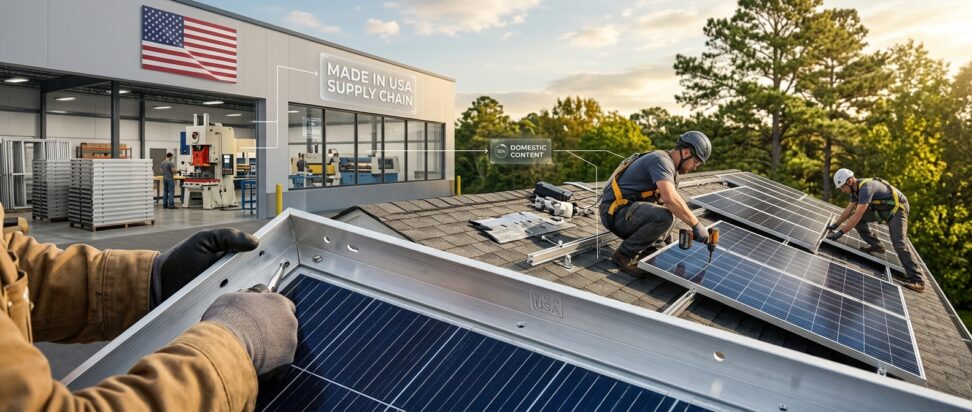
Qcells Launches US-Made Frames for Residential Solar Panels
Qcells has begun integrating domestically manufactured aluminum frames into its residential solar panel lineup, marking another step in the company’s push to build a fully US-based solar supply chain. The move strengthens the company’s ability to qualify for domestic content incentives under the Inflation Reduction Act while reducing reliance on imported components.
Qcells, the solar manufacturing arm of Korean conglomerate Hanwha Group, has been expanding its US manufacturing footprint for several years. The company operates a large-scale solar panel and cell production complex in Dalton, Georgia, and has invested heavily in Cartersville, Georgia, to build out additional capacity across the solar value chain, including ingots, wafers, cells, and now frame components.
What the New Frames Mean for Homeowners
The domestically produced frames will be used in Qcells’ residential panel products, allowing installers and homeowners to access panels that meet a higher threshold of US content. This matters because federal tax incentives, particularly the domestic content bonus under the IRA, reward projects that use a specified percentage of American-made materials and components.
For residential solar customers, panels built with more domestic content can translate into stronger eligibility for incentive stacking, potentially lowering the overall cost of a solar installation when paired with other available credits.
- Frames are now manufactured within the US supply chain rather than imported
- Supports higher domestic content percentages for IRA tax credit qualification
- Applies to Qcells’ residential panel product lineup
- Builds on existing Georgia-based manufacturing operations
Expanding a Vertically Integrated Supply Chain
This frame announcement follows Qcells’ broader strategy of vertical integration within the United States. Over the past several years, the company has worked to localize production of ingots, wafers, cells, and modules, reducing dependence on components sourced from Asia. Adding frame manufacturing to that list closes another gap in the domestic supply chain for solar hardware.
Aluminum frames are a structural necessity for solar panels, providing rigidity and a mounting point for racking systems. Historically, many US module assemblers imported these frames from overseas suppliers, even when cells and panels were assembled domestically. By bringing frame production onshore, Qcells aims to close that loophole in its supply chain and offer a more complete “Made in America” product.
Context: Domestic Content and Policy Pressure
The timing of this expansion reflects ongoing policy dynamics in the US solar industry. The domestic content bonus credit under the Inflation Reduction Act offers additional tax benefits to solar projects that meet specific thresholds of US-manufactured steel, iron, and manufactured products. As these requirements have tightened over time, solar manufacturers have faced growing pressure to source more components domestically or risk losing access to the full value of available incentives.
Additionally, trade policy affecting imported solar components, including tariffs and anti-dumping duties on panels and parts from certain countries, has made domestic sourcing more commercially attractive for manufacturers like Qcells. Building frame capacity within the US also provides some insulation from potential supply chain disruptions or price volatility tied to international shipping and trade disputes.
Qcells’ Broader US Investment Strategy
Qcells has positioned itself as one of the largest solar manufacturers investing in US production capacity. The company’s Georgia operations are part of a multibillion-dollar investment plan announced in recent years, aimed at creating a comprehensive solar manufacturing ecosystem within the United States. This includes not only panel assembly but also upstream production of solar cells and the raw materials that go into them.
The addition of US-made frames fits into this larger pattern of incremental localization. Rather than announcing a single massive facility, Qcells has been filling in specific gaps in its supply chain over time, from cell production to now structural components like frames.
What This Means for the Solar Industry
For installers and solar companies working with Qcells products, the shift to domestic frames could simplify compliance with domestic content requirements for projects seeking federal incentives. It may also appeal to homeowners who prioritize supporting US manufacturing jobs or want added assurance about the sourcing of the materials in their solar systems.
As the residential solar market continues to navigate policy changes, tariff uncertainty, and evolving incentive structures, moves like this one from Qcells reflect a broader trend among manufacturers to build more resilient, domestically rooted supply chains. Whether other manufacturers follow with similar frame localization efforts may depend on how strongly the market rewards verified domestic content in the coming years.
Qcells has not detailed specific production volumes or additional facility investments tied to this particular announcement, but the move aligns with its stated long-term goal of building a complete solar manufacturing supply chain on US soil.
Analyzed and outlined by Claude Sonnet 5, images by Gemini 3.1 Flash.
**Source** https://www.pv-magazine.com/2026/10/17/qcells-to-introduce-u-s-domestic-frames-for-residential-solar-panel-lineup/