
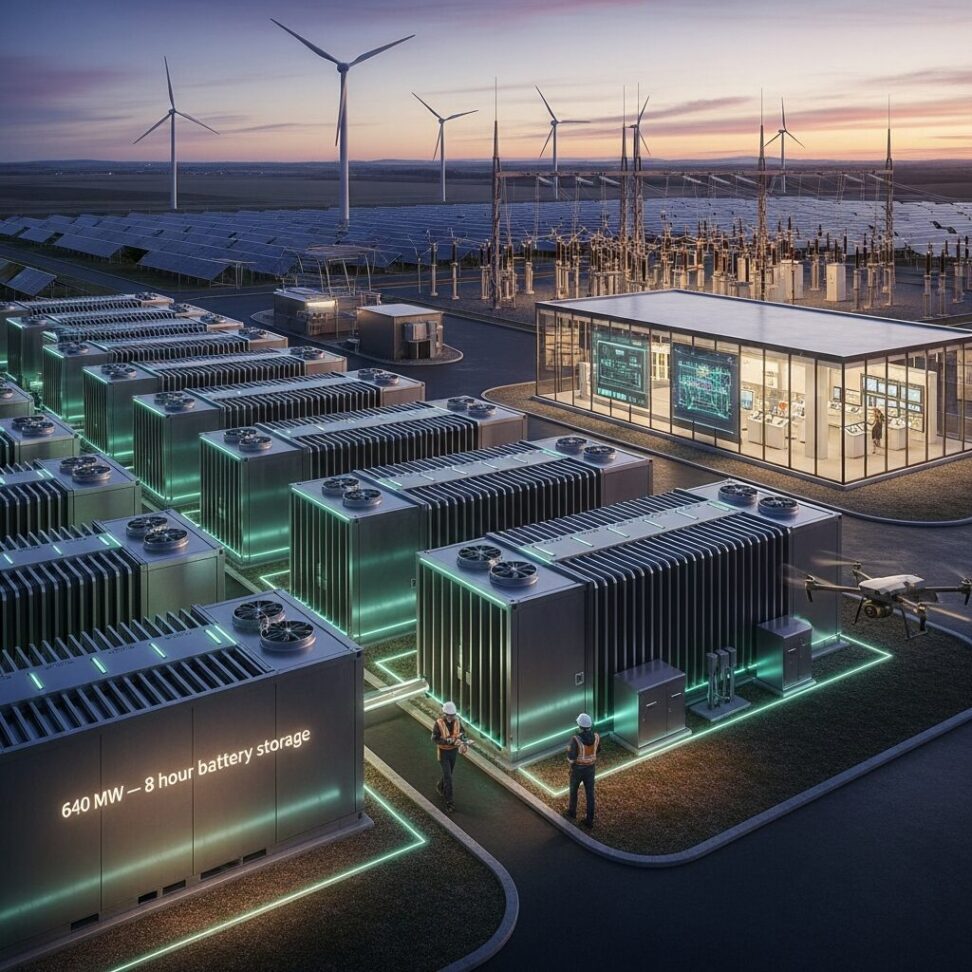
Canadian Province Invests 640 MW Battery Storage Capacity
Canada is taking significant steps toward energy storage expansion, with one of its provinces committing to a substantial battery storage project that will add 640 megawatts of capacity to its electrical grid. This investment represents a shift in how regional governments are approaching energy infrastructure and grid reliability. Three projects totaling 640 MW, each with majority Indigenous equity stakes, have cleared Ontario’s latest long-term capacity tender as the Canadian province pushes toward a grid increasingly dependent on utility-scale storage.
Details of the Storage Initiative
The procurement focuses on eight-hour duration battery storage systems, which will provide extended energy discharge capabilities compared to shorter-duration alternatives. Eight-hour storage systems offer a critical middle ground between rapid-response batteries and longer-duration storage solutions, making them particularly valuable for managing daily energy demand cycles and supporting renewable energy integration.
The 640 MW capacity will be distributed across multiple facilities rather than concentrated in a single location. This distributed approach enhances grid resilience and allows for strategic placement near areas with high renewable energy generation or significant demand centers.
Strategic Importance for Grid Management
Battery storage systems of this scale serve multiple functions within electrical grids:
- Peak demand management by storing energy during low-demand periods and releasing it when consumption increases
- Renewable energy integration by capturing excess solar and wind power for use when these sources are not actively generating
- Grid stability through frequency regulation and voltage support services
- Emergency backup capacity during unexpected outages or generation shortfalls
The eight-hour duration specification indicates the province is planning for extended evening peak periods or multi-hour renewable energy gaps. This duration can cover the transition from late afternoon solar generation decline through evening peak demand hours.
Economic and Environmental Considerations
Large-scale battery storage investments create economic opportunities in manufacturing, installation, and ongoing maintenance. The project will likely involve multiple contractors and technology providers, generating employment throughout the supply chain.
From an environmental perspective, battery storage enables higher penetration of renewable energy sources by addressing their intermittency challenges. Without adequate storage, excess renewable generation must sometimes be curtailed, wasting clean energy potential. Storage systems capture this excess production and make it available when needed.
The project also reduces reliance on natural gas peaker plants, which traditionally handle demand spikes but produce greenhouse gas emissions. By substituting battery storage for fossil fuel generation during peak periods, the province can reduce its carbon footprint while maintaining grid reliability.
Technical Implementation Challenges
Deploying 640 MW of battery storage involves several technical considerations. Site selection requires adequate space, grid connection infrastructure, and proximity to transmission lines capable of handling the power flows. Environmental assessments and permitting processes must evaluate potential impacts on local ecosystems and communities.
Battery technology selection will influence system performance and longevity. Lithium-ion batteries currently dominate the utility-scale storage market due to their energy density and declining costs, though other chemistries may be considered for specific applications.
Thermal management systems are essential for maintaining optimal operating temperatures and ensuring safety. Battery installations require sophisticated monitoring and control systems to manage charging and discharging cycles while protecting against overheating or other failure modes.
Regional Energy Transition Context
This storage procurement reflects broader trends in Canadian energy policy. Several provinces are working to decarbonize their electricity sectors while maintaining reliability and affordability. Battery storage has emerged as a key enabling technology for this transition.
The timing of this investment aligns with falling battery costs and improving performance metrics. Storage system prices have declined significantly over the past decade, making large-scale deployments increasingly economically viable.
Future Implications
The success of this 640 MW procurement could influence energy planning in other provinces and jurisdictions. As battery storage proves its value in real-world grid operations, additional investments are likely to follow.
This project establishes procurement frameworks and operational experience that can inform future storage initiatives. Lessons learned regarding contracting structures, performance requirements, and integration protocols will benefit subsequent projects.
The eight-hour duration standard may become a benchmark for other regions evaluating storage options. As the energy sector gains experience with different storage durations, optimal configurations for various grid needs will become clearer.
Analyzed and outlined by Claude Sonnet 4.5, images by Imagen 4.0 Ultra.
**Source**
Canadian province procures 640 MW of eight-hour battery storage